Advertisements
Advertisements
प्रश्न
A body of mass 0.40 kg moving initially with a constant speed of 10 m s–1 to the north is subject to a constant force of 8.0 N directed towards the south for 30 s. Take the instant the force is applied to be t = 0, the position of the body at that time to be x = 0, and predict its position at t = –5 s, 25 s, 100 s.
Advertisements
उत्तर
Mass of the body, m = 0.40 kg
Initial speed of the body, u = 10 m/s due north
Force acting on the body, F = -8.0 N
Acceleration produced in the body, `a = "F"/"m" = (-8.0)/(0.40) = -20 "m/s"^2`
(i) At t = -5s
Acceleration, a' = 0 and u = 10 m/s
`"S" = "ut" + 1/2 "at"^2`
= 10 × (-5) = -50 m
(ii) At t = 25 s
Acceleration, a'' = -20 m/s2 and u = 10 m/s
S = ut + `1/2` at2
`= 10 xx 25 + 1/2 xx (-20) xx (25)^2`
= 250 + 6250 = -6000 m
(iii) At t = 100 s
For `0 <= t <= 30`
a = –20 m/s2
u = 10 m/s
S1 = ut + `1/2` at2
`= 10 xx 30 + 1/2 xx (-20) xx (30)^2`
= 300 - 9000
= -8700 m
For 30' < t <= 100s
As per the first equation of motion, for t = 30 s, final velocity is given as:
v = u + at
= 10 + (-20) × 30 = -590 m/s
Velocity of the body after 30 s = -590 m/s
For motion between 30 s to 100 s, i.e., in 70 s:
S2 = vt
= -590 × 70 = -41300 m
∴ Total distance, S = s1 + s2 = -8700 - 41300 = -50000 m
APPEARS IN
संबंधित प्रश्न
A man of mass 70 kg stands on a weighing scale in a lift which is moving
- upwards with a uniform speed of 10 m s-1
- downwards with a uniform acceleration of 5 m s–2
- upwards with a uniform acceleration of 5 m s–2. What would be the readings on the scale in each case?
- What would be the reading if the lift mechanism failed and it hurtled down freely under gravity?
A batsman deflects a ball by an angle of 45° without changing its initial speed which is equal to 54 km/h. What is the impulse imparted to the ball? (Mass of the ball is 0.15 kg.)
A helicopter of mass 1000 kg rises with a vertical acceleration of 15 m s–2. The crew and the passengers weigh 300 kg. Give the magnitude and direction of the
(a) force on the floor by the crew and passengers,
(b) action of the rotor of the helicopter on the surrounding air,
(c) force on the helicopter due to the surrounding air.
A person drops a coin. Describe the path of the coin as seen by the person if he is in
- a car moving at constant velocity and
- in a free falling elevator.
An object is placed far away from all the objects that can exert force on it. A frame of reference is constructed by taking the origin and axes fixed in this object. Will the frame be necessarily inertial?
A smooth wedge A is fitted in a chamber hanging from a fixed ceiling near the earth's surface. A block B placed at the top of the wedge takes time T to slide down the length of the wedge. If the block is placed at the top of the wedge and the cable supporting the chamber is broken at the same instant, the block will.
A force \[\vec{F} = \vec{v} \times \vec{A}\] is exerted on a particle in addition to the force of gravity, where \[\vec{v}\] is the velocity of the particle and \[\vec{A}\] is a constant vector in the horizontal direction. With what minimum speed, a particle of mass m be projected so that it continues to move without being defelected and with a constant velocity?
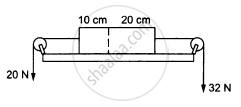
In the following figure shows a uniform rod of length 30 cm and mass 3.0 kg. The strings shown in the figure are pulled by constant forces of 20 N and 32 N. Find the force exerted by the 20 cm part of the rod on the 10 cm part. All the surfaces are smooth and the strings and the pulleys are light.
In the previous problem, suppose m2 = 2.0 kg and m3 = 3.0 kg. What should be the mass m, so that it remains at rest?
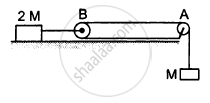
Consider the situation shown in the following figure. Both the pulleys and the string are light and all the surfaces are frictionless.
- Find the acceleration of the mass M.
- Find the tension in the string.
- Calculate the force exerted by the clamp on the pulley A in the figure.
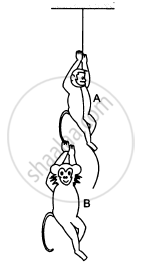
The monkey B, shown in the following figure, is holding on to the tail of monkey A that is climbing up a rope. The masses of monkeys A and B are 5 kg and 2 kg, respectively. If A can tolerate a tension of 30 N in its tail, what force should it apply on the rope in order to carry monkey B with it? Take g = 10 m/s2.
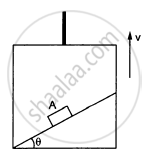
A block A can slide on a frictionless incline of angle θ and length l, kept inside an elevator going up with uniform velocity v in the following figure. Find the time taken by the block to slide down the length of the incline if it is released from the top of the incline.
Write the mathematical form of Newton's second law of motion. State the conditions if any.
State Newton's second law of motion. Under what condition does it take the form F = ma?
The correct form of Newton's second law is :
How long will a stone take to fall to the ground from the top of a building 80 m high
Prove mathematically F = ma
A stone is thrown vertically upward with a velocity of 9.8 m/s. When will it reach the ground?
A metre scale is moving with uniform velocity. This implies ______.
In the previous problem (5.3), the magnitude of the momentum transferred during the hit is ______.
