Advertisements
Advertisements
Question
A body of mass 0.40 kg moving initially with a constant speed of 10 m s–1 to the north is subject to a constant force of 8.0 N directed towards the south for 30 s. Take the instant the force is applied to be t = 0, the position of the body at that time to be x = 0, and predict its position at t = –5 s, 25 s, 100 s.
Advertisements
Solution
Mass of the body, m = 0.40 kg
Initial speed of the body, u = 10 m/s due north
Force acting on the body, F = -8.0 N
Acceleration produced in the body, `a = "F"/"m" = (-8.0)/(0.40) = -20 "m/s"^2`
(i) At t = -5s
Acceleration, a' = 0 and u = 10 m/s
`"S" = "ut" + 1/2 "at"^2`
= 10 × (-5) = -50 m
(ii) At t = 25 s
Acceleration, a'' = -20 m/s2 and u = 10 m/s
S = ut + `1/2` at2
`= 10 xx 25 + 1/2 xx (-20) xx (25)^2`
= 250 + 6250 = -6000 m
(iii) At t = 100 s
For `0 <= t <= 30`
a = –20 m/s2
u = 10 m/s
S1 = ut + `1/2` at2
`= 10 xx 30 + 1/2 xx (-20) xx (30)^2`
= 300 - 9000
= -8700 m
For 30' < t <= 100s
As per the first equation of motion, for t = 30 s, final velocity is given as:
v = u + at
= 10 + (-20) × 30 = -590 m/s
Velocity of the body after 30 s = -590 m/s
For motion between 30 s to 100 s, i.e., in 70 s:
S2 = vt
= -590 × 70 = -41300 m
∴ Total distance, S = s1 + s2 = -8700 - 41300 = -50000 m
APPEARS IN
RELATED QUESTIONS
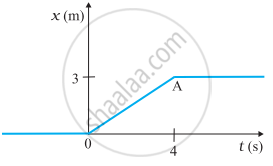
The below figure shows the position-time graph of a particle of mass 4 kg.
- What is the force on the particle for t < 0, t > 4 s, 0 < t < 4 s?
- What is the impulse at t = 0 and t = 4 s? (Consider one-dimensional motion only.)
Two bodies of masses 10 kg and 20 kg respectively kept on a smooth, horizontal surface are tied to the ends of a light string. A horizontal force F = 600 N is applied to
- A,
- B along the direction of string. What is the tension in the string in each case?
Explain why a cricketer moves his hands backwards while holding a catch.
An aircraft executes a horizontal loop at a speed of 720 km/h with its wings banked at 15°. What is the radius of the loop?
A block of mass 15 kg is placed on a long trolley. The coefficient of static friction between the block and the trolley is 0.18. The trolley accelerates from rest with 0.5 ms–2 for 20 s and then moves with uniform velocity. Discuss the motion of the block as viewed by (a) a stationary observer on the ground, (b) an observer moving with the trolley.
car moving at 40 km/hr is to be stopped by applying brakes in the next 4 m. If the car weighs 2000 kg, what average force must be applied to stop it?
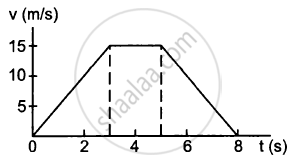
A particle of mass 50 g moves in a straight line. The variation of speed with time is shown in the following figure. Find the force acting on the particle at t = 2, 4 and 6 seconds.
Two blocks A and B of mass mA and mB , respectively, are kept in contact on a frictionless table. The experimenter pushes block A from behind, so that the blocks accelerate. If block A exerts force F on block B, what is the force exerted by the experimenter on block A?
A man has fallen into a ditch of width d and two of his friends are slowly pulling him out using a light rope and two fixed pulleys as shown in the following figure. Show that the force (assumed equal for both the friends) exerted by each friend on the road increases as the man moves up. Find the force when the man is at a depth h.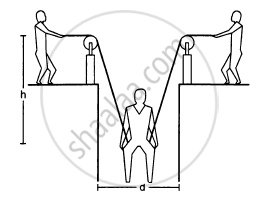
A block is kept on the floor of an elevator at rest. The elevator starts descending with an acceleration of 12 m/s2. Find the displacement of the block during the first 0.2 s after the start. Take g = 10 m/s2.
Define linear momentum and state its S.I. unit.
Two bodies A and B of same mass are moving with velocities v and 2v, respectively. Compare their (i) inertia and (ii) momentum.
Use Newton's second law of motion to explain the following instance :
A cricketer pulls his hands back while catching a fast moving cricket ball .
A force of 10 N acts on a body of mass 2 kg for 3 s, initially at rest. Calculate : The velocity acquired by the body
A force acts for 10 s on a stationary body of mass 100 kg, after which the force ceases to act. The body moves through a distance of 100 m in the next 5 s. Calculate: The velocity acquired by the body.
A ball is thrown vertically downward with an initial velocity of 10 m/s. What is its speed 1 s later and 2 s later?
A cricket ball of mass 150 g has an initial velocity `u = (3hati + 4hatj)` m s−1 and a final velocity `v = - (3hati + 4hatj)` m s−1 after being hit. The change in momentum (final momentum-initial momentum) is (in kg m s1)
Why does a child feel more pain when she falls down on a hard cement floor, than when she falls on the soft muddy ground in the garden?
How does moving your hand backward while catching a cricket ball reduce pain?
