Advertisements
Advertisements
Question
The motion of a particle of mass m is given by x = 0 for t < 0 s, x(t) = A sin 4 pt for 0 < t < (1/4) s (A > o), and x = 0 for t > (1/4) s. Which of the following statements is true?
- The force at t = (1/8) s on the particle is – 16π2 Am.
- The particle is acted upon by on impulse of magnitude 4π2 A m at t = 0 s and t = (1/4) s.
- The particle is not acted upon by any force.
- The particle is not acted upon by a constant force.
- There is no impulse acting on the particle.
Advertisements
Solution
a, b and d
Explanation:
Given, `x = 0` for `t < 0 s`.
`x(t) = A sin 4pit`; for `0 < t < 1/4 s`
`x = 0`; for `t > 1/4 s`
For, `0 < t < 1/4 s`
`v(t) = (dx)/(dt) = 4π A cos 4πt`
`a(t)` = acceleration
= `(dv(t))/(dt)`
= – 16π2 A sin 4 πt
At `t = 1/8 s, a(t) = - 16 π^2 A sin 4π xx 1/8 = - 16π^2 A`
`F = ma (t) = - 16 π^2` A × m = `- 16 π^2` mA
Impulse = Change in linear momentum
= `F xx t = (- 16 π^2 Am) xx 1/4`
= `- 4π^2 Am`
The impulse (Change in linear momentum) at t = 0 is the same as, t = `1/4 s`.
Clearly, force depends upon A which is not constant. Hence, force is also not constant.
APPEARS IN
RELATED QUESTIONS
A person drops a coin. Describe the path of the coin as seen by the person if he is in
- a car moving at constant velocity and
- in a free falling elevator.
Suppose you are running fast in a field and suddenly find a snake in front of you. You stop quickly. Which force is responsible for your deceleration?
Two objects A and B are thrown upward simultaneously with the same speed. The mass of A is greater than that of B. Suppose the air exerts a constant and equal force of resistance on the two bodies.
In a TV picture tube, electrons are ejected from the cathode with negligible speed and they attain a velocity of 5 × 10⁶ m/s in travelling one centimetre. Assuming straight-line motion, find the constant force exerted on the electrons. The mass of an electron is 9.1 × 10⁻³¹ kg.
A block of mass 0.2 kg is suspended from the ceiling by a light string. A second block of mass 0.3 kg is suspended from the first block by another string. Find the tensions in the two strings. Take g = 10 m/s2.
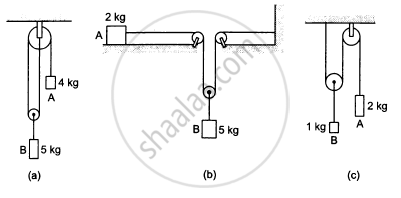
Find the acceleration of the blocks A and B in the three situations shown in the following figure.
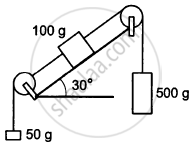
Find the acceleration of the 500 g block in the following figure.
Two bodies A and B of same mass are moving with velocities v and 2v, respectively. Compare their (i) inertia and (ii) momentum.
A pebble is thrown vertically upwards with a speed of 20 m s-1. How high will it be after 2 s? (Take g = 10 m s-2)
How long will a stone take to fall to the ground from the top of a building 80 m high
A stone is dropped freely from the top of a tower and it reaches the ground in 4 s. Taking g = 10m s-2, calculate the height of the tower.
A pebble is dropped freely in a well from its top. It takes 20 s for the pebble to reach the water surface in the well. Taking g = 10 m s-2 and speed of sound = 330 m s-1. Find : The time when echo is heard after the pebble is dropped.
Define Newton’s second law of motion.
ame the law of motion which gives the definition of force.
What causes motion in a body?
State Newton's second law of motion. Is Newton's first law of motion contained in Newton's second law of motion?
A stone is thrown vertically upward with a velocity of 9.8 m/s. When will it reach the ground?
What do you mean by the conservation of momentum? Briefly, explain the collision between two bodies and the conservation of momentum.
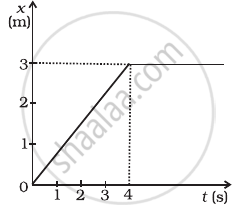
The position time graph of a body of mass 2 kg is as given in figure. What is the impulse on the body at t = 0 s and t = 4 s.
According to Newton's Second Law of Motion, what quantity is directly proportional to the applied force?
