Advertisements
Advertisements
Question
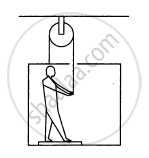
In the following figure shows a man of mass 60 kg standing on a light weighing machine kept in a box of mass 30 kg. The box is hanging from a pulley fixed to the ceiling by a light rope, the other end of which is held by the man himself. If the man manages to keep the box at rest, what is the weight recorded on the machine? What force should he exert on the rope to record his correct weight on the machine?
Advertisements
Solution
(i) Given, mass of the man = 60 kg
Let W' = apparent weight of the man in this case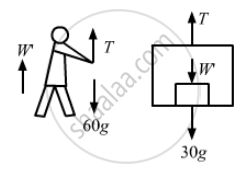
From the free-body diagram of the man,
W' + T − 60g = 0
⇒ T = 60g − W' ...(i)
From the free-body diagram of the box,
T − W' = 30g = 0 ...(ii)
From equation (i), we get:
60g − W' − W' − 30g = 0
⇒ W' = 15g
Hence, the weight recorded on the machine is 15 kg.
(ii) To find his actual weight, suppose the force applied by the men on the rope is T because of which the box accelerates upward with an acceleration a'.Here we need to find\[\ T'\]
Correct weight = W = 60g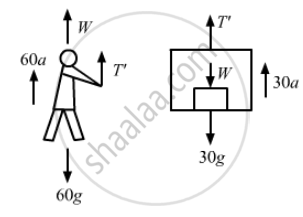
From the free-body diagram of the man,
T' + W − 60g − 60a = 0
⇒ T' − 60a = 0
⇒ T' = 60a ...(i)
From the free-body diagram of the box,
T' − W − 30g − 30a = 0
⇒ T' − 60g − 30g − 30a = 0
⇒ T' = 30a − 900 ...(ii)
From equations (i) and (ii), we get:
T' = 2T' − 1800
T' = 1800 N
So, the man should exert a force of 1800 N on the rope to record his correct weight on the machine.
APPEARS IN
RELATED QUESTIONS
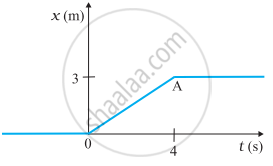
The below figure shows the position-time graph of a particle of mass 4 kg.
- What is the force on the particle for t < 0, t > 4 s, 0 < t < 4 s?
- What is the impulse at t = 0 and t = 4 s? (Consider one-dimensional motion only.)
An object is placed far away from all the objects that can exert force on it. A frame of reference is constructed by taking the origin and axes fixed in this object. Will the frame be necessarily inertial?
Suppose you are running fast in a field and suddenly find a snake in front of you. You stop quickly. Which force is responsible for your deceleration?
A smooth wedge A is fitted in a chamber hanging from a fixed ceiling near the earth's surface. A block B placed at the top of the wedge takes time T to slide down the length of the wedge. If the block is placed at the top of the wedge and the cable supporting the chamber is broken at the same instant, the block will.
The figure shows the displacement of a particle going along the X-axis as a function of time. The force acting on the particle is zero in the region
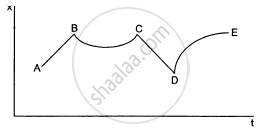
(a) AB
(b) BC
(c) CD
(d) DE
A person says that he measured the acceleration of a particle to be non-zero even though no force was acting on the particle.
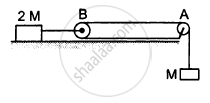
Consider the situation shown in the following figure. Both the pulleys and the string are light and all the surfaces are frictionless.
- Find the acceleration of the mass M.
- Find the tension in the string.
- Calculate the force exerted by the clamp on the pulley A in the figure.
Two balls A and B of masses m and 2 m are in motion with velocities 2v and v, respectively. Compare:
(i) Their inertia.
(ii) Their momentum.
(iii) The force needed to stop them in the same time.
The unit of linear momentum is :
A body of mass 5 kg is moving with velocity 2 m s-1. Calculate its linear momentum.
A force of 10 N acts on a body of mass 2 kg for 3 s, initially at rest. Calculate : Change in momentum of the body.
A bullet of mass 50 g moving with an initial velocity 100 m s-1 strikes a wooden block and comes to rest after penetrating a distance 2 cm in it. Calculate: (i) Initial momentum of the bullet, (ii) Final momentum of the bullet, (iii) Retardation caused by the wooden block and (iv) Resistive force exerted by the wooden block.
How long will a stone take to fall to the ground from the top of a building 80 m high
Name the physical entity used for quantifying the motion of a body.
A ball is thrown upward and reaches a maximum height of 19.6 m. Find its initial speed?
The INCORRECT statement about Newton's second law of motion is
A cricket ball of mass 150 g has an initial velocity `u = (3hati + 4hatj)` m s−1 and a final velocity `v = - (3hati + 4hatj)` m s−1 after being hit. The change in momentum (final momentum-initial momentum) is (in kg m s1)
A hockey player is moving northward and suddenly turns westward with the same speed to avoid an opponent. The force that acts on the player is ______.
What happens when a car brakes to come to a stop?
How does moving your hand backward while catching a cricket ball reduce pain?
