Advertisements
Advertisements
Question
A ball is thrown upward and reaches a maximum height of 19.6 m. Find its initial speed?
Advertisements
Solution
Maximum Height attained by ball = 19.6 m
Let initial speed of ball = u ms-1.
Acceleration applied on ball due to gravity = -9.8 ms-2.
Final speed of ball at maximum height = 0 ms-1.
We know that from second equation of motion
V2 - u2 = 2as
0 -u2 = 2 X(-9.8)X19.6
u2 = 19.6 X 19.6
u= 19.6 ms-1
So initial speed of ball to attain maximum height of 19.6 m should be 19.6ms-1.
APPEARS IN
RELATED QUESTIONS
A constant retarding force of 50 N is applied to a body of mass 20 kg moving initially with a speed of 15 ms–1. How long does the body take to stop?
Two blocks A and B of mass mA and mB , respectively, are kept in contact on a frictionless table. The experimenter pushes block A from behind, so that the blocks accelerate. If block A exerts force F on block B, what is the force exerted by the experimenter on block A?
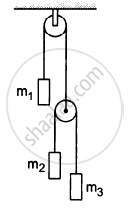
Let m1 = 1 kg, m2 = 2 kg and m3 = 3 kg in the following figure. Find the accelerations of m1, m2 and m3. The string from the upper pulley to m1 is 20 cm when the system is released from rest. How long will it take before m1 strikes the pulley?
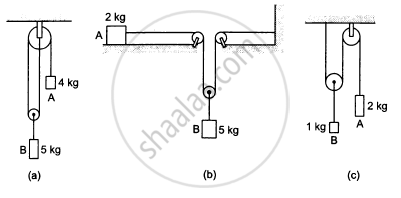
Find the acceleration of the blocks A and B in the three situations shown in the following figure.
A body of mass 5 kg is moving with velocity 2 m s-1. Calculate its linear momentum.
An electron of mass 9 × 10⁻³¹ kg is moving with a linear velocity of 6 × 10⁷ ms−1. Calculate the linear momentum of electron.
What do you understand by the term momentum?
A ball is thrown vertically downward with an initial velocity of 10 m/s. What is its speed 1 s later and 2 s later?
What do you mean by the conservation of momentum? Briefly, explain the collision between two bodies and the conservation of momentum.
According to Newton's Second Law of Motion, what quantity is directly proportional to the applied force?
