Advertisements
Advertisements
Question
Two blocks A and B of mass mA and mB , respectively, are kept in contact on a frictionless table. The experimenter pushes block A from behind, so that the blocks accelerate. If block A exerts force F on block B, what is the force exerted by the experimenter on block A?
Advertisements
Solution
Let F' = force exerted by the experimenter on block A and F be the force exerted by block A on block B.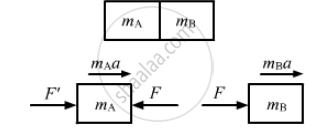
Let a be the acceleration produced in the system.
For block A,
\[F' - F = m_A a\] ...(1)
For block B,
F = mBa ...(2)
Dividing equation (1) by (2), we get:
\[\frac{F'}{F} - 1 = \frac{m_A}{m_B}\]
\[\Rightarrow F' = F\left( 1 + \frac{m_A}{m_B} \right)\]
∴ Force exerted by the experimenter on block A is
\[F\left( 1 + \frac{m_A}{m_B} \right)\]
APPEARS IN
RELATED QUESTIONS
A spy jumps from an airplane with his parachute. The spy accelerates downward for some time when the parachute opens. The acceleration is suddenly checked and the spy slowly falls to the ground. Explain the action of the parachute in checking the acceleration.
A free 238U nucleus kept in a train emits an alpha particle. When the train is stationary, a nucleus decays and a passenger measures that the separation between the alpha particle and the recoiling nucleus becomes x at time t after the decay. If the decay takes place while the train is moving at a uniform velocity v, the distance between the alpha particle and the recoiling nucleus at a time t after the decay, as measured by the passenger, is
In a TV picture tube, electrons are ejected from the cathode with negligible speed and they attain a velocity of 5 × 10⁶ m/s in travelling one centimetre. Assuming straight-line motion, find the constant force exerted on the electrons. The mass of an electron is 9.1 × 10⁻³¹ kg.
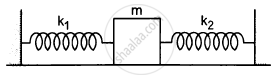
Both the springs shown in the following figure are unstretched. If the block is displaced by a distance x and released, what will be the initial acceleration?
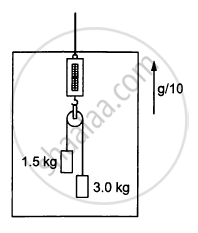
Find the reading of the spring balance shown in the following figure. The elevator is going up with an acceleration g/10, the pulley and the string are light and the pulley is smooth.
The force of buoyancy exerted by the atmosphere on a balloon is B in the upward direction and remains constant. The force of air resistance on the balloon acts opposite the direction of velocity and is proportional to it. The balloon carries a mass M and is found to fall to the earth's surface with a constant velocity v. How much mass should be removed from the balloon so that it may rise with a constant velocity v?
An empty plastic box of mass m is found to accelerate up at the rate of g/6 when placed deep inside water. How much sand should be put inside the box so that it may accelerate down at the rate of g/6?
A force \[\vec{F} = \vec{v} \times \vec{A}\] is exerted on a particle in addition to the force of gravity, where \[\vec{v}\] is the velocity of the particle and \[\vec{A}\] is a constant vector in the horizontal direction. With what minimum speed, a particle of mass m be projected so that it continues to move without being defelected and with a constant velocity?
In the previous problem, suppose m2 = 2.0 kg and m3 = 3.0 kg. What should be the mass m, so that it remains at rest?
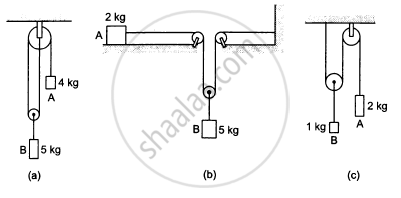
Find the acceleration of the blocks A and B in the three situations shown in the following figure.
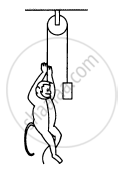
A monkey is climbing on a rope that goes over a smooth light pulley and supports a block of equal mass at the other end in the following figure. Show that whatever force the monkey exerts on the rope, the monkey and the block move in the same direction with equal acceleration. If initially both were at rest, their separation will not change as time passes.
An electron of mass 9 × 10⁻³¹ kg is moving with a linear velocity of 6 × 10⁷ ms−1. Calculate the linear momentum of electron.
Define Newton’s second law of motion.
Name the physical entity used for quantifying the motion of a body.
What do you mean by linear momentum of a body?
A metre scale is moving with uniform velocity. This implies ______.
In the previous problem (5.3), the magnitude of the momentum transferred during the hit is ______.
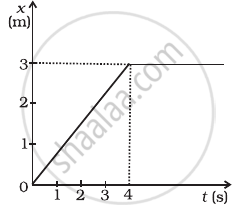
The position time graph of a body of mass 2 kg is as given in figure. What is the impulse on the body at t = 0 s and t = 4 s.