Advertisements
Advertisements
Question
An empty plastic box of mass m is found to accelerate up at the rate of g/6 when placed deep inside water. How much sand should be put inside the box so that it may accelerate down at the rate of g/6?
Advertisements
Solution
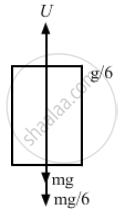
Let U be the upward force of water acting on the plastic box.
Let m be the initial mass of the plastic box.
When the empty plastic box is accelerating upward,
\[U - mg = \frac{mg}{6}\]
\[ \Rightarrow U = \frac{7 mg}{6}\]
\[\Rightarrow m = \frac{6U}{7g} . . . . \left( i \right)\]
Let M be the final mass of the box after putting some sand in it.
\[Mg - U = \frac{Mg}{6}\]
\[ \Rightarrow Mg - \frac{Mg}{6} = U\]
\[ \Rightarrow M = \frac{6U}{5g} . . . . \left( ii \right)\]
Mass added
\[= \frac{6U}{5g} - \frac{6U}{7g}\]
\[= \frac{6U\left( 7 - 5 \right)}{35 g}\]
\[ = \frac{6U \cdot 2}{35 g}\]
From equation (i),
\[m = \frac{6U}{7g}\]
∴ Mass added
\[= \frac{2}{5}m\]
APPEARS IN
RELATED QUESTIONS
Two masses 8 kg and 12 kg are connected at the two ends of a light, inextensible string that goes over a frictionless pulley. Find the acceleration of the masses, and the tension in the string when the masses are released.
A batsman deflects a ball by an angle of 45° without changing its initial speed which is equal to 54 km/h. What is the impulse imparted to the ball? (Mass of the ball is 0.15 kg.)
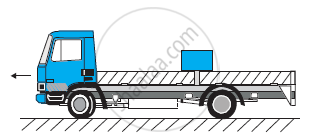
The rear side of a truck is open and a box of 40 kg mass is placed 5 m away from the open end as shown in Figure. The coefficient of friction between the box and the surface below it is 0.15. On a straight road, the truck starts from rest and accelerates with 2 m s–2. At what distance from the starting point does the box fall off the truck? (Ignore the size of the box).
When a horse pulls a cart, the force that helps the horse to move forward is the force exerted by
Two objects A and B are thrown upward simultaneously with the same speed. The mass of A is greater than that of B. Suppose the air exerts a constant and equal force of resistance on the two bodies.
The figure shows the displacement of a particle going along the X-axis as a function of time. The force acting on the particle is zero in the region
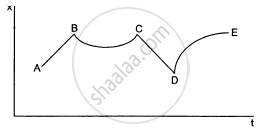
(a) AB
(b) BC
(c) CD
(d) DE
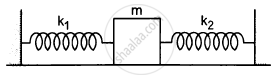
Both the springs shown in the following figure are unstretched. If the block is displaced by a distance x and released, what will be the initial acceleration?
In the following figure, m1 = 5 kg, m2 = 2 kg and F = 1 N. Find the acceleration of either block. Describe the motion of m1 if the string breaks but F continues to act.
In the previous problem, suppose m2 = 2.0 kg and m3 = 3.0 kg. What should be the mass m, so that it remains at rest?
A tennis ball and a cricket ball , both are stationary. To start motion in them .
Define linear momentum and state its S.I. unit.
How can Newton's first law of motion be obtained from the second law of motion?
Use Newton's second law of motion to explain the following instance :
A cricketer pulls his hands back while catching a fast moving cricket ball .
A bullet of mass 50 g moving with an initial velocity 100 m s-1 strikes a wooden block and comes to rest after penetrating a distance 2 cm in it. Calculate: (i) Initial momentum of the bullet, (ii) Final momentum of the bullet, (iii) Retardation caused by the wooden block and (iv) Resistive force exerted by the wooden block.
Prove mathematically F = ma
Name the physical entity used for quantifying the motion of a body.
What causes motion in a body?
What do you mean by linear momentum of a body?
A stone is dropped from a cliff 98 m high.
What will be its speed when it strikes the ground?
A metre scale is moving with uniform velocity. This implies ______.
