Advertisements
Advertisements
Question
A stone is dropped from a tower 98 m high. With what speed should a second stone be thrown 1 s later so that both hit the ground at the same time?
Advertisements
Solution
Height of tower = 98 m
Acceleration due to gravity on stone = 9.8 ms-2.
Initial speed of ball= 0 ms-1.
Let initial speed of second stone is v ms-1.
We know from second equation of motion
S = ut + 1/2 a Xt2.
98 = 0 + 1/2 X9.8Xt2.
t2 = 20
t= 4.47 sec.
As second stone is thrown 1 sec later so time taken by second body to cover distance of 98 m is = 4.47 - 1 = 3.47sec.
So again put t= 3.47 sec and S = 98 m in second equation of motion we get
98 = vX3.47 + 1/2 X9.8X3.47X3.47.
98 = 3.47Xv + 59
3.47X v = 98 - 59
v= 39/3.47 = 11.23 ms-1.
Initial speed of second stone should be 11.23 ms-1.
APPEARS IN
RELATED QUESTIONS
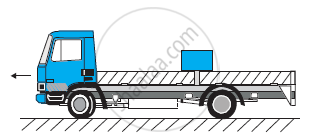
The rear side of a truck is open and a box of 40 kg mass is placed 5 m away from the open end as shown in Figure. The coefficient of friction between the box and the surface below it is 0.15. On a straight road, the truck starts from rest and accelerates with 2 m s–2. At what distance from the starting point does the box fall off the truck? (Ignore the size of the box).
You are travelling in a car. The driver suddenly applies the brakes and you are pushed forward. Why does this happen?
A spy jumps from an airplane with his parachute. The spy accelerates downward for some time when the parachute opens. The acceleration is suddenly checked and the spy slowly falls to the ground. Explain the action of the parachute in checking the acceleration.
A free 238U nucleus kept in a train emits an alpha particle. When the train is stationary, a nucleus decays and a passenger measures that the separation between the alpha particle and the recoiling nucleus becomes x at time t after the decay. If the decay takes place while the train is moving at a uniform velocity v, the distance between the alpha particle and the recoiling nucleus at a time t after the decay, as measured by the passenger, is
In a TV picture tube, electrons are ejected from the cathode with negligible speed and they attain a velocity of 5 × 10⁶ m/s in travelling one centimetre. Assuming straight-line motion, find the constant force exerted on the electrons. The mass of an electron is 9.1 × 10⁻³¹ kg.
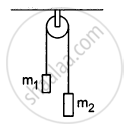
In a simple Atwood machine, two unequal masses m1 and m2 are connected by a string going over a clamped light smooth pulley. In a typical arrangement (In the following figure), m1 = 300 g and m2 = 600 g. The system is released from rest. (a) Find the distance travelled by the first block in the first two seconds; (b) find the tension in the string; (c) find the force exerted by the clamp on the pulley.
Show that the rate of change of momentum = mass × acceleration. Under what condition does this relation hold?
Calculate the magnitude of force which when applied on a body of mass 0.5 kg produces an acceleration of 5 m s-2.
How long will a stone take to fall to the ground from the top of a building 80 m high
A stone is dropped from a cliff 98 m high.
How long will it take to fall to the foot of the cliff?
