Advertisements
Advertisements
प्रश्न
A stone is dropped from a tower 98 m high. With what speed should a second stone be thrown 1 s later so that both hit the ground at the same time?
Advertisements
उत्तर
Height of tower = 98 m
Acceleration due to gravity on stone = 9.8 ms-2.
Initial speed of ball= 0 ms-1.
Let initial speed of second stone is v ms-1.
We know from second equation of motion
S = ut + 1/2 a Xt2.
98 = 0 + 1/2 X9.8Xt2.
t2 = 20
t= 4.47 sec.
As second stone is thrown 1 sec later so time taken by second body to cover distance of 98 m is = 4.47 - 1 = 3.47sec.
So again put t= 3.47 sec and S = 98 m in second equation of motion we get
98 = vX3.47 + 1/2 X9.8X3.47X3.47.
98 = 3.47Xv + 59
3.47X v = 98 - 59
v= 39/3.47 = 11.23 ms-1.
Initial speed of second stone should be 11.23 ms-1.
APPEARS IN
संबंधित प्रश्न
A stone of mass m tied to the end of a string revolves in a vertical circle of radius R. The net forces at the lowest and highest points of the circle directed vertically downwards are: [Choose the correct alternative]
| Lowest Point | Highest Point | |
| a) | mg – T1 | mg + T2 |
| b) | mg + T1 | mg – T2 |
| c) | `mg + T1 –(m_v_1^2)/R` | mg – T2 + (`mv_1^2`)/R |
| d) | `mg – T1 – (mv)/R` | mg + T2 + (mv_1^2)/R |
T1 and v1 denote the tension and speed at the lowest point. T2 and v2 denote corresponding values at the highest point.
A smooth wedge A is fitted in a chamber hanging from a fixed ceiling near the earth's surface. A block B placed at the top of the wedge takes time T to slide down the length of the wedge. If the block is placed at the top of the wedge and the cable supporting the chamber is broken at the same instant, the block will.
A force \[\vec{F} = \vec{v} \times \vec{A}\] is exerted on a particle in addition to the force of gravity, where \[\vec{v}\] is the velocity of the particle and \[\vec{A}\] is a constant vector in the horizontal direction. With what minimum speed, a particle of mass m be projected so that it continues to move without being defelected and with a constant velocity?
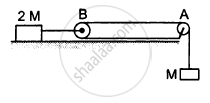
Consider the situation shown in the following figure. Both the pulleys and the string are light and all the surfaces are frictionless.
- Find the acceleration of the mass M.
- Find the tension in the string.
- Calculate the force exerted by the clamp on the pulley A in the figure.
Use Newton's second law of motion to explain the following instance :
A cricketer pulls his hands back while catching a fast moving cricket ball .
A bullet of mass 50 g moving with an initial velocity 100 m s-1 strikes a wooden block and comes to rest after penetrating a distance 2 cm in it. Calculate: (i) Initial momentum of the bullet, (ii) Final momentum of the bullet, (iii) Retardation caused by the wooden block and (iv) Resistive force exerted by the wooden block.
Define Newton’s second law of motion.
Multiple Choice Question. Select the correct option.
A force acts on a body of mass 3 kg such that its velocity changes from 4 ms−1 to 10 ms−1. The change in momentum of the body is
State Newton's second law of motion. Is Newton's first law of motion contained in Newton's second law of motion?
According to Newton's Second Law of Motion, what quantity is directly proportional to the applied force?
