Advertisements
Advertisements
प्रश्न
A bullet of mass 50 g moving with an initial velocity 100 m s-1 strikes a wooden block and comes to rest after penetrating a distance 2 cm in it. Calculate: (i) Initial momentum of the bullet, (ii) Final momentum of the bullet, (iii) Retardation caused by the wooden block and (iv) Resistive force exerted by the wooden block.
Advertisements
उत्तर
Mass, m = 50 gm = 0.05 kg.
Initial velocity, u = 100 m/s.
Final velocity, v = 0.
Distance, s = 2cm = 0.02 m.
(i) Initial momentum = mu = (0.05) (100) = 5 kg m/s-1
(ii) Final momentum = mv = (0.05) (0) = 0 kg m/s.
(iii) Acceleration, a = (v2 - u2)/2s.
Or, a = (02 - 1002)/ 2(0.02).
Or, a = -2.5 105 ms-2.
Therefore, retardation is 2.5 × 10⁵ ms-2.
(iv) Force, F = ma
Or, F = (0.05 kg) (2.5 × 10⁵ ms-2)
Or, F = 12500 N
APPEARS IN
संबंधित प्रश्न
Two masses 8 kg and 12 kg are connected at the two ends of a light, inextensible string that goes over a frictionless pulley. Find the acceleration of the masses, and the tension in the string when the masses are released.
An aircraft executes a horizontal loop at a speed of 720 km/h with its wings banked at 15°. What is the radius of the loop?
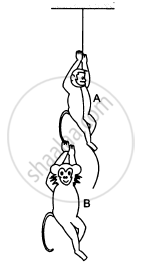
The monkey B, shown in the following figure, is holding on to the tail of monkey A that is climbing up a rope. The masses of monkeys A and B are 5 kg and 2 kg, respectively. If A can tolerate a tension of 30 N in its tail, what force should it apply on the rope in order to carry monkey B with it? Take g = 10 m/s2.
An aeroplane is moving uniformly at a constant height under the action of two forces (i) Upward force (lift) and (ii) Downward force (weight). What is the net force on the aeroplane?
Two bodies A and B of same mass are moving with velocities v and 2v, respectively. Compare their (i) inertia and (ii) momentum.
The linear momentum of a ball of mass 50 g is 0.5 kg m s-1. Find its velocity.
A force acts for 10 s on a stationary body of mass 100 kg, after which the force ceases to act. The body moves through a distance of 100 m in the next 5 s. Calculate: The velocity acquired by the body.
State two factors which determine the momentum of a body.
What causes motion in a body?
Why is it advantageous to turn before taking a long jump?
