Advertisements
Advertisements
प्रश्न
A bullet of mass 50 g moving with an initial velocity 100 m s-1 strikes a wooden block and comes to rest after penetrating a distance 2 cm in it. Calculate: (i) Initial momentum of the bullet, (ii) Final momentum of the bullet, (iii) Retardation caused by the wooden block and (iv) Resistive force exerted by the wooden block.
Advertisements
उत्तर
Mass, m = 50 gm = 0.05 kg.
Initial velocity, u = 100 m/s.
Final velocity, v = 0.
Distance, s = 2cm = 0.02 m.
(i) Initial momentum = mu = (0.05) (100) = 5 kg m/s-1
(ii) Final momentum = mv = (0.05) (0) = 0 kg m/s.
(iii) Acceleration, a = (v2 - u2)/2s.
Or, a = (02 - 1002)/ 2(0.02).
Or, a = -2.5 105 ms-2.
Therefore, retardation is 2.5 × 10⁵ ms-2.
(iv) Force, F = ma
Or, F = (0.05 kg) (2.5 × 10⁵ ms-2)
Or, F = 12500 N
APPEARS IN
संबंधित प्रश्न
Two masses 8 kg and 12 kg are connected at the two ends of a light, inextensible string that goes over a frictionless pulley. Find the acceleration of the masses, and the tension in the string when the masses are released.
car moving at 40 km/hr is to be stopped by applying brakes in the next 4 m. If the car weighs 2000 kg, what average force must be applied to stop it?
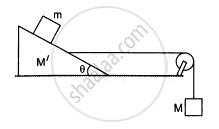
Find the mass M of the hanging block in the following figure that will prevent the smaller block from slipping over the triangular block. All the surfaces are frictionless and the strings and the pulleys are light.
A force acts for 10 s on a stationary body of mass 100 kg, after which the force ceases to act. The body moves through a distance of 100 m in the next 5 s. Calculate: The velocity acquired by the body.
A force acts for 10 s on a stationary body of mass 100 kg, after which the force ceases to act. The body moves through a distance of 100 m in the next 5 s. Calculate : The magnitude of the force
Calculate the velocity of a body of mass 0.5 kg, when it has a linear momentum of 5 Ns.
State Newton's second law of motion. Is Newton's first law of motion contained in Newton's second law of motion?
What do you mean by linear momentum of a body? A force causes an acceleration of 10 ms-2 in a body of mass 1 kg. What acceleration will be caused by the same force in a body of mass 4 kg?
A ball is thrown upward and reaches a maximum height of 19.6 m. Find its initial speed?
How does moving your hand backward while catching a cricket ball reduce pain?
