Advertisements
Advertisements
प्रश्न
If the tension in the cable supporting an elevator is equal to the weight of the elevator, the elevator may be
(a) going up with increasing speed
(b) going down with increasing speed
(c) going up with uniform speed
(d) going down with uniform speed
Advertisements
उत्तर
(c) going up with uniform speed
(d) going down with uniform speed
Tension in the cable = Weight of the elevator
Or, total upward force = total downward force
That is, there's no acceleration or uniform velocity.
So, the elevator is going up/down with uniform speed.
APPEARS IN
संबंधित प्रश्न
A rocket with a lift-off mass 20,000 kg is blasted upwards with an initial acceleration of 5.0 m s–2. Calculate the initial thrust (force) of the blast.
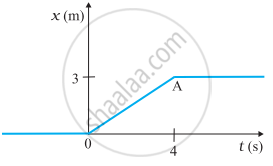
The below figure shows the position-time graph of a particle of mass 4 kg.
- What is the force on the particle for t < 0, t > 4 s, 0 < t < 4 s?
- What is the impulse at t = 0 and t = 4 s? (Consider one-dimensional motion only.)
A stone of mass m tied to the end of a string revolves in a vertical circle of radius R. The net forces at the lowest and highest points of the circle directed vertically downwards are: [Choose the correct alternative]
| Lowest Point | Highest Point | |
| a) | mg – T1 | mg + T2 |
| b) | mg + T1 | mg – T2 |
| c) | `mg + T1 –(m_v_1^2)/R` | mg – T2 + (`mv_1^2`)/R |
| d) | `mg – T1 – (mv)/R` | mg + T2 + (mv_1^2)/R |
T1 and v1 denote the tension and speed at the lowest point. T2 and v2 denote corresponding values at the highest point.
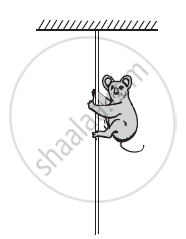
A monkey of mass 40 kg climbs on a rope in given Figure which can stand a maximum tension of 600 N. In which of the following cases will the rope break: the monkey
(a) climbs up with an acceleration of 6 m s–2
(b) climbs down with an acceleration of 4 m s–2
(c) climbs up with a uniform speed of 5 m s–1
(d) falls down the rope nearly freely under gravity?
(Ignore the mass of the rope).
An object is placed far away from all the objects that can exert force on it. A frame of reference is constructed by taking the origin and axes fixed in this object. Will the frame be necessarily inertial?
A block is kept on the floor of an elevator at rest. The elevator starts descending with an acceleration of 12 m/s2. Find the displacement of the block during the first 0.2 s after the start. Take g = 10 m/s2.
A tennis ball and a cricket ball , both are stationary. To start motion in them .
A body of mass m moving with a velocity v is acted upon by a force. Write an expression for change in momentum in each of the following cases: (i) When v << c, (ii) When v → c and (iii) When v << c but m does not remain constant. Here, c is the speed of light.
Two bodies A and B of same mass are moving with velocities v and 2v, respectively. Compare their (i) inertia and (ii) momentum.
A pebble is thrown vertically upwards with a speed of 20 m s-1. How high will it be after 2 s? (Take g = 10 m s-2)
How long will a stone take to fall to the ground from the top of a building 80 m high
A body of mass 200 g is moving with a velocity of 5 ms−1. If the velocity of the body changes to 17 ms−1, calculate the change in linear momentum of the body.
Define Newton’s second law of motion.
Multiple Choice Question. Select the correct option.
Which of the following are vector quantities?
What do you mean by linear momentum of a body?
Name the physical quantity which equals the rate of change of linear momentum.
State Newton's second law of motion.
A body of mass 400 g is resting on a frictionless table. Find the acceleration of the body when acted upon by a force of 0.02 N.
A stone is dropped from a cliff 98 m high.
How long will it take to fall to the foot of the cliff?
A stone is dropped from a tower 98 m high. With what speed should a second stone be thrown 1 s later so that both hit the ground at the same time?
In the previous problem (5.3), the magnitude of the momentum transferred during the hit is ______.
