Advertisements
Advertisements
प्रश्न
What do you mean by linear momentum of a body?
Advertisements
उत्तर
Linear Momentum is defined as the amount of motion contained in a body. It is given by the product of the mass of the body and its velocity.
APPEARS IN
संबंधित प्रश्न
Explain why a cricketer moves his hands backwards while holding a catch.
You are travelling in a car. The driver suddenly applies the brakes and you are pushed forward. Why does this happen?
A block of mass m is placed on a smooth wedge of inclination θ. The whole system is accelerated horizontally so that the block does not slip on the wedge. The force exerted by the wedge on the block has a magnitude.
State the magnitude and direction of the force of gravity acting on the body of mass 5 kg. Take g = 9.8 m s-2.
Define Newton’s second law of motion.
Name the physical entity used for quantifying the motion of a body.
A ball is thrown vertically downward with an initial velocity of 10 m/s. What is its speed 1 s later and 2 s later?
What do you mean by the conservation of momentum? Briefly, explain the collision between two bodies and the conservation of momentum.
Why is catching a slow-moving ball easier than catching a fast-moving ball?
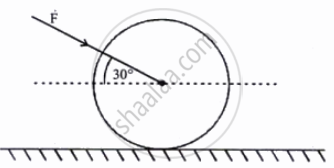
As shown in figure, a 70 kg garden roller is pushed with a force of F = 200 N at an angle of 30° with horizontal. The normal reaction on the roller is: (Given: g = 10 ms−2)