Advertisements
Advertisements
प्रश्न
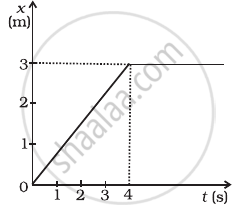
The position time graph of a body of mass 2 kg is as given in figure. What is the impulse on the body at t = 0 s and t = 4 s.
Advertisements
उत्तर
Given, the mass of the body (m) = 2 kg
From the position-time graph, the body is at x = 0 when t = 0, i.e., body is at rest.
∴ Impulse at t = 0, s = 0, is zero
From t =0 s to t = 4 s, the position-time graph is a straight line, which shows that body moves with uniform velocity.
Beyond t = 4 s, the graph is a straight line parallel to time ads, i.e., the body is at rest (v = 0).
The velocity of the body = slope of a position-time graph
= tan θ = `3/4` m/s
impulse (at t = 4 s) = change in momentum
= mv – mu
= m(v – u)
= `2(0 - 3/4)`
= `- 3/2` kg-m/s = – 1.5 kg-m/s
APPEARS IN
संबंधित प्रश्न
A constant retarding force of 50 N is applied to a body of mass 20 kg moving initially with a speed of 15 ms–1. How long does the body take to stop?
A batsman deflects a ball by an angle of 45° without changing its initial speed which is equal to 54 km/h. What is the impulse imparted to the ball? (Mass of the ball is 0.15 kg.)
car moving at 40 km/hr is to be stopped by applying brakes in the next 4 m. If the car weighs 2000 kg, what average force must be applied to stop it?
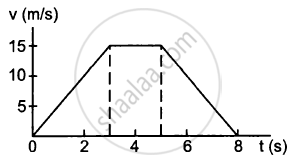
A particle of mass 50 g moves in a straight line. The variation of speed with time is shown in the following figure. Find the force acting on the particle at t = 2, 4 and 6 seconds.
The force of buoyancy exerted by the atmosphere on a balloon is B in the upward direction and remains constant. The force of air resistance on the balloon acts opposite the direction of velocity and is proportional to it. The balloon carries a mass M and is found to fall to the earth's surface with a constant velocity v. How much mass should be removed from the balloon so that it may rise with a constant velocity v?
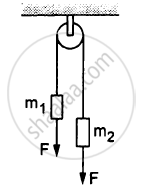
In the following figure, m1 = 5 kg, m2 = 2 kg and F = 1 N. Find the acceleration of either block. Describe the motion of m1 if the string breaks but F continues to act.
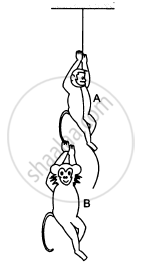
The monkey B, shown in the following figure, is holding on to the tail of monkey A that is climbing up a rope. The masses of monkeys A and B are 5 kg and 2 kg, respectively. If A can tolerate a tension of 30 N in its tail, what force should it apply on the rope in order to carry monkey B with it? Take g = 10 m/s2.
A tennis ball and a cricket ball , both are stationary. To start motion in them .
How can Newton's first law of motion be obtained from the second law of motion?
A force of 10 N acts on a body of mass 2 kg for 3 s, initially at rest. Calculate : The velocity acquired by the body
ame the law of motion which gives the definition of force.
Name the physical entity used for quantifying the motion of a body.
What causes motion in a body?
Why is it advantageous to turn before taking a long jump?
State Newton's second law of motion. Is Newton's first law of motion contained in Newton's second law of motion?
In the previous problem (5.3), the magnitude of the momentum transferred during the hit is ______.
A hockey player is moving northward and suddenly turns westward with the same speed to avoid an opponent. The force that acts on the player is ______.
According to Newton's Second Law of Motion, what quantity is directly proportional to the applied force?
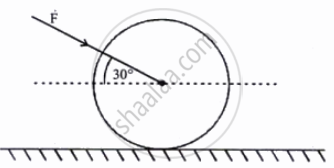
As shown in figure, a 70 kg garden roller is pushed with a force of F = 200 N at an angle of 30° with horizontal. The normal reaction on the roller is: (Given: g = 10 ms−2)