Advertisements
Advertisements
प्रश्न
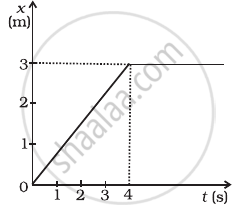
The position time graph of a body of mass 2 kg is as given in figure. What is the impulse on the body at t = 0 s and t = 4 s.
Advertisements
उत्तर
Given, the mass of the body (m) = 2 kg
From the position-time graph, the body is at x = 0 when t = 0, i.e., body is at rest.
∴ Impulse at t = 0, s = 0, is zero
From t =0 s to t = 4 s, the position-time graph is a straight line, which shows that body moves with uniform velocity.
Beyond t = 4 s, the graph is a straight line parallel to time ads, i.e., the body is at rest (v = 0).
The velocity of the body = slope of a position-time graph
= tan θ = `3/4` m/s
impulse (at t = 4 s) = change in momentum
= mv – mu
= m(v – u)
= `2(0 - 3/4)`
= `- 3/2` kg-m/s = – 1.5 kg-m/s
APPEARS IN
संबंधित प्रश्न
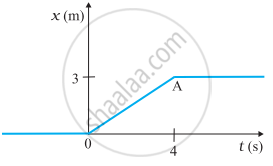
The below figure shows the position-time graph of a particle of mass 4 kg.
- What is the force on the particle for t < 0, t > 4 s, 0 < t < 4 s?
- What is the impulse at t = 0 and t = 4 s? (Consider one-dimensional motion only.)
A force \[\vec{F} = \vec{v} \times \vec{A}\] is exerted on a particle in addition to the force of gravity, where \[\vec{v}\] is the velocity of the particle and \[\vec{A}\] is a constant vector in the horizontal direction. With what minimum speed, a particle of mass m be projected so that it continues to move without being defelected and with a constant velocity?
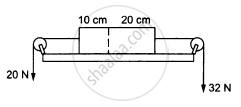
In the following figure shows a uniform rod of length 30 cm and mass 3.0 kg. The strings shown in the figure are pulled by constant forces of 20 N and 32 N. Find the force exerted by the 20 cm part of the rod on the 10 cm part. All the surfaces are smooth and the strings and the pulleys are light.
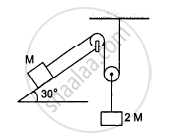
Find the acceleration of the block of mass M in the situation shown in the following figure. All the surfaces are frictionless and the pulleys and the string are light.
A monkey of mass 15 kg is climbing a rope fixed to a ceiling. If it wishes to go up with an acceleration of 1 m/s2, how much force should it apply on the rope? If the rope is 5 m long and the monkey starts from rest, how much time will it take to reach the ceiling?
A block is kept on the floor of an elevator at rest. The elevator starts descending with an acceleration of 12 m/s2. Find the displacement of the block during the first 0.2 s after the start. Take g = 10 m/s2.
Two bodies A and B of same mass are moving with velocities v and 2v, respectively. Compare their (i) inertia and (ii) momentum.
State Newton's second law of motion. Under what condition does it take the form F = ma?
Use Newton's second law of motion to explain the following instance :
An athlete prefers to land on sand instead of hard floor while taking a high jump .
A bullet of mass 50 g moving with an initial velocity 100 m s-1 strikes a wooden block and comes to rest after penetrating a distance 2 cm in it. Calculate: (i) Initial momentum of the bullet, (ii) Final momentum of the bullet, (iii) Retardation caused by the wooden block and (iv) Resistive force exerted by the wooden block.
A stone is dropped freely from the top of a tower and it reaches the ground in 4 s. Taking g = 10m s-2, calculate the height of the tower.
Calculate the velocity of a body of mass 0.5 kg, when it has a linear momentum of 5 Ns.
Multiple Choice Question. Select the correct option.
The impulse of a body is equal to:
Multiple Choice Question. Select the correct option.
A force acts on a body of mass 3 kg such that its velocity changes from 4 ms−1 to 10 ms−1. The change in momentum of the body is
State Newton's second law of motion. Is Newton's first law of motion contained in Newton's second law of motion?
A stone is dropped from a cliff 98 m high.
How long will it take to fall to the foot of the cliff?
A stone is dropped from a cliff 98 m high.
What will be its speed when it strikes the ground?
A ball is thrown vertically downward with an initial velocity of 10 m/s. What is its speed 1 s later and 2 s later?
Why is catching a slow-moving ball easier than catching a fast-moving ball?
