Advertisements
Advertisements
प्रश्न
A monkey of mass 15 kg is climbing a rope fixed to a ceiling. If it wishes to go up with an acceleration of 1 m/s2, how much force should it apply on the rope? If the rope is 5 m long and the monkey starts from rest, how much time will it take to reach the ceiling?
Advertisements
उत्तर
Mass of the monkey, m = 15 kg,
Acceleration of the monkey in the upward direction, a = 1 m/s2
The free-body diagram of the monkey is shown below: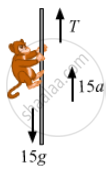
From the free-body diagram,
T − [15g + 15(a)] = 0
T − [15g + 15(1)] = 0
⇒ T = 5 (10 + 1)
⇒ T = 15 × 11 = 165 N
The monkey should apply a force of 165 N to the rope.
Initial velocity, u = 0
s = 5 m
Using, \[s = ut + \frac{1}{2}a t^2\], we get:
\[5 = 0 + \left( \frac{1}{2} \right) \times 1 \times t^2 \]
\[ \Rightarrow t^2 = 5 \times 2\]
\[ \Rightarrow t = \sqrt{10} s\]
Hence, the time required to reach the ceiling is \[\sqrt{10} s\]
APPEARS IN
संबंधित प्रश्न
Two masses 8 kg and 12 kg are connected at the two ends of a light, inextensible string that goes over a frictionless pulley. Find the acceleration of the masses, and the tension in the string when the masses are released.
Explain why a cricketer moves his hands backwards while holding a catch.
An aircraft executes a horizontal loop at a speed of 720 km/h with its wings banked at 15°. What is the radius of the loop?
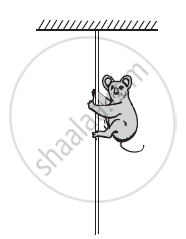
A monkey of mass 40 kg climbs on a rope in given Figure which can stand a maximum tension of 600 N. In which of the following cases will the rope break: the monkey
(a) climbs up with an acceleration of 6 m s–2
(b) climbs down with an acceleration of 4 m s–2
(c) climbs up with a uniform speed of 5 m s–1
(d) falls down the rope nearly freely under gravity?
(Ignore the mass of the rope).
A block of mass 15 kg is placed on a long trolley. The coefficient of static friction between the block and the trolley is 0.18. The trolley accelerates from rest with 0.5 ms–2 for 20 s and then moves with uniform velocity. Discuss the motion of the block as viewed by (a) a stationary observer on the ground, (b) an observer moving with the trolley.
When a horse pulls a cart, the force that helps the horse to move forward is the force exerted by
A smooth wedge A is fitted in a chamber hanging from a fixed ceiling near the earth's surface. A block B placed at the top of the wedge takes time T to slide down the length of the wedge. If the block is placed at the top of the wedge and the cable supporting the chamber is broken at the same instant, the block will.
A free 238U nucleus kept in a train emits an alpha particle. When the train is stationary, a nucleus decays and a passenger measures that the separation between the alpha particle and the recoiling nucleus becomes x at time t after the decay. If the decay takes place while the train is moving at a uniform velocity v, the distance between the alpha particle and the recoiling nucleus at a time t after the decay, as measured by the passenger, is
The force of buoyancy exerted by the atmosphere on a balloon is B in the upward direction and remains constant. The force of air resistance on the balloon acts opposite the direction of velocity and is proportional to it. The balloon carries a mass M and is found to fall to the earth's surface with a constant velocity v. How much mass should be removed from the balloon so that it may rise with a constant velocity v?
In the previous problem, suppose m2 = 2.0 kg and m3 = 3.0 kg. What should be the mass m, so that it remains at rest?
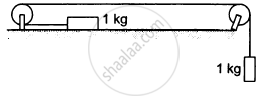
Calculate the tension in the string shown in the following figure. The pulley and the string are light and all the surfaces are frictionless. Take g = 10 m/s2.
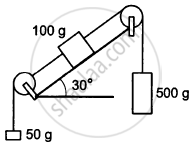
Find the acceleration of the 500 g block in the following figure.
Two balls A and B of masses m and 2 m are in motion with velocities 2v and v, respectively. Compare:
(i) Their inertia.
(ii) Their momentum.
(iii) The force needed to stop them in the same time.
Write the mathematical form of Newton's second law of motion. State the conditions if any.
How long will a stone take to fall to the ground from the top of a building 80 m high
Calculate the velocity of a body of mass 0.5 kg, when it has a linear momentum of 5 Ns.
A stone is thrown vertically upward with a velocity of 9.8 m/s. When will it reach the ground?
A stone is dropped from a tower 98 m high. With what speed should a second stone be thrown 1 s later so that both hit the ground at the same time?
A cricket ball of mass 150 g has an initial velocity `u = (3hati + 4hatj)` m s−1 and a final velocity `v = - (3hati + 4hatj)` m s−1 after being hit. The change in momentum (final momentum-initial momentum) is (in kg m s1)
