Advertisements
Advertisements
प्रश्न
An electron of mass 9 × 10⁻³¹ kg is moving with a linear velocity of 6 × 10⁷ ms−1. Calculate the linear momentum of electron.
Advertisements
उत्तर
Mass of electron = m = 9 × 10⁻³¹ kg
Velocity of electron = v = 6 × 10⁷ ms−1
Momentum of electron = P = ?
We know, P = mv
P = 9.1 × 10−31 × 6 × 107
P = 54 × 10−24 kg ms−1 or Ns
= 54 × 10−24 kg ms−1 Ns
APPEARS IN
संबंधित प्रश्न
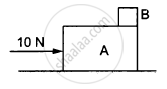
A small block B is placed on another block A of mass 5 kg and length 20 cm. Initially, the block B is near the right end of block A (In the following Figure). A constant horizontal force of 10 N is applied to the block A. All the surfaces are assumed frictionless. Find the time that elapses before block B separates from A.
An empty plastic box of mass m is found to accelerate up at the rate of g/6 when placed deep inside water. How much sand should be put inside the box so that it may accelerate down at the rate of g/6?
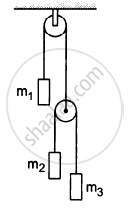
Let m1 = 1 kg, m2 = 2 kg and m3 = 3 kg in the following figure. Find the accelerations of m1, m2 and m3. The string from the upper pulley to m1 is 20 cm when the system is released from rest. How long will it take before m1 strikes the pulley?
A monkey of mass 15 kg is climbing a rope fixed to a ceiling. If it wishes to go up with an acceleration of 1 m/s2, how much force should it apply on the rope? If the rope is 5 m long and the monkey starts from rest, how much time will it take to reach the ceiling?
A body of mass 5 kg is moving with velocity 2 m s-1. Calculate its linear momentum.
Calculate the velocity of a body of mass 0.5 kg, when it has a linear momentum of 5 Ns.
A motorcycle of mass 100 kg is running at 10 ms−1. If its engine develops an extra linear momentum of 2000 Ns, calculate the new velocity of a motorcycle.
Multiple Choice Question. Select the correct option.
A force acts on a body of mass 3 kg such that its velocity changes from 4 ms−1 to 10 ms−1. The change in momentum of the body is
A ball is thrown upward and reaches a maximum height of 19.6 m. Find its initial speed?
Why does a child feel more pain when she falls down on a hard cement floor, than when she falls on the soft muddy ground in the garden?
