Advertisements
Advertisements
प्रश्न
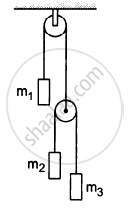
Let m1 = 1 kg, m2 = 2 kg and m3 = 3 kg in the following figure. Find the accelerations of m1, m2 and m3. The string from the upper pulley to m1 is 20 cm when the system is released from rest. How long will it take before m1 strikes the pulley?
Advertisements
उत्तर
The free-body diagram for mass m1 is shown below: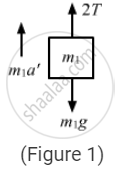 a
a
The free-body diagram for mass m2 is shown below: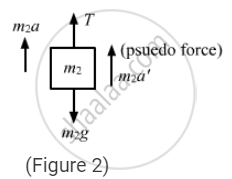
The free-body diagram for mass m3 is shown below: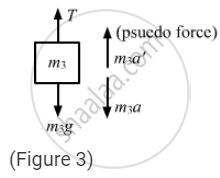
Suppose the block m1 moves upward with acceleration a1 and the blocks m2 and m3have relative acceleration a2 due to the difference of weight between them.
So, the actual acceleration of the blocks m1, m2 and m3 will be a1, (a1 − a2) and (a1 + a2), as shown.
From figure 2, T − 1g − 1a1 = 0 ...(i)
From figure 3,\[\frac{T}{2} - 2g - 2\left( a_1 - a_2 \right) = 0 . . . \left( ii \right)\]
From figure 4,\[\frac{T}{2} - 3g - 3\left( a_1 + a_2 \right) = 0 . . . \left( iii \right)\]
From equations (i) and (ii), eliminating T, we get:
1g + 1a2 = 4g + 4 (a1 + a2)
5a2 − 4a1 = 3g ...(iv)
From equations (ii) and (iii), we get:
2g + 2(a1 − a2) = 3g − 3 (a1 − a2)
5a1 + a2 = g ...(v)
Solving equations (iv) and (v), we get:
\[a_1 = \frac{2g}{29}\]
\[\text{ and }a_2 = g - 5 a_1 \]
\[ \Rightarrow a_2 = g - \frac{10g}{29} = \frac{19g}{29}\]
\[\text{So}, a_1 - a_2 = \frac{2g}{29} - \frac{19g}{29} = - \frac{17g}{29}\]
So, accelerations of m1, m2 and m3 are \[\frac{19g}{29}\left( up \right),
\frac{17g}{29} \left(\text{ down }\right)\text{ and }\frac{21g}{29}\left(\text{ down }\right)\]
Now, u = 0, s = 20 cm = 0.2 m
\[a_2 = \frac{19g}{29} \]
\[ \therefore s = ut + \frac{1}{2}a t^2 \]
\[ \Rightarrow 0 . 2 = \frac{1}{2} \times \frac{19}{29}g t^2 \]
\[ \Rightarrow t = 0 . 25 s\]
APPEARS IN
संबंधित प्रश्न
In a TV picture tube, electrons are ejected from the cathode with negligible speed and they attain a velocity of 5 × 10⁶ m/s in travelling one centimetre. Assuming straight-line motion, find the constant force exerted on the electrons. The mass of an electron is 9.1 × 10⁻³¹ kg.
The force of buoyancy exerted by the atmosphere on a balloon is B in the upward direction and remains constant. The force of air resistance on the balloon acts opposite the direction of velocity and is proportional to it. The balloon carries a mass M and is found to fall to the earth's surface with a constant velocity v. How much mass should be removed from the balloon so that it may rise with a constant velocity v?
An empty plastic box of mass m is found to accelerate up at the rate of g/6 when placed deep inside water. How much sand should be put inside the box so that it may accelerate down at the rate of g/6?
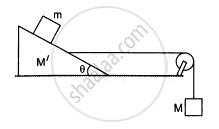
Find the mass M of the hanging block in the following figure that will prevent the smaller block from slipping over the triangular block. All the surfaces are frictionless and the strings and the pulleys are light.
State Newton's second law of motion. Under what condition does it take the form F = ma?
The unit of linear momentum is :
The linear momentum of a body of mass m moving with velocity v is :
The linear momentum of a ball of mass 50 g is 0.5 kg m s-1. Find its velocity.
A force of 10 N acts on a body of mass 2 kg for 3 s, initially at rest. Calculate : The velocity acquired by the body
A car is moving with a uniform velocity 30 ms-1. It is stopped in 2 s by applying a force of 1500 N through its brakes. Calculate the following values : The change in momentum of car.
A motorcycle of mass 100 kg is running at 10 ms−1. If its engine develops an extra linear momentum of 2000 Ns, calculate the new velocity of a motorcycle.
What do you understand by the term momentum?
State two factors which determine the momentum of a body.
Name the physical entity used for quantifying the motion of a body.
What do you mean by linear momentum of a body?
Name the physical quantity which equals the rate of change of linear momentum.
A stone is dropped from a cliff 98 m high.
How long will it take to fall to the foot of the cliff?
A metre scale is moving with uniform velocity. This implies ______.
A woman throws an object of mass 500 g with a speed of 25 ms1.
- What is the impulse imparted to the object?
- If the object hits a wall and rebounds with half the original speed, what is the change in momentum of the object?
Why is catching a slow-moving ball easier than catching a fast-moving ball?
