Advertisements
Advertisements
प्रश्न
Prove mathematically F = ma
Advertisements
उत्तर
Derivation of F = ma from Newton’s Second Law of Motion:
Newton introduced the concept of momentum and say “The momentum of a moving body is defined as the product of its mass and velocity.”
Thus, p = mv, where p = momentum of body
m = mass of body
v = velocity of body
Suppose the velocity of body of mass m changes from u to v in time t.
Initial momentum, p1 = mu
and final momentum, p2 = mv
the change in momentum, (p2 − p1) takes place in time t. Then according to Newton’s second law of motion, the magnitude of force F is:
`("P"_2-"P"_1)/"t"` α F, or F = `("km"("v"-"u"))/"t"`
Where k = constant of proportionality
Now, `"a"(("v"-"u"))/"t"`, where a = acceleration of body
∴ F = k ma
⇒ F = ma .............(∵ k = 1, constant)
This relation holds good when mass of the body remains constant.
APPEARS IN
संबंधित प्रश्न
An object is placed far away from all the objects that can exert force on it. A frame of reference is constructed by taking the origin and axes fixed in this object. Will the frame be necessarily inertial?
A car accelerates on a horizontal road due to the force exerted by.
If the tension in the cable supporting an elevator is equal to the weight of the elevator, the elevator may be
(a) going up with increasing speed
(b) going down with increasing speed
(c) going up with uniform speed
(d) going down with uniform speed
A person says that he measured the acceleration of a particle to be non-zero even though no force was acting on the particle.
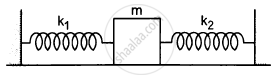
Both the springs shown in the following figure are unstretched. If the block is displaced by a distance x and released, what will be the initial acceleration?
A force \[\vec{F} = \vec{v} \times \vec{A}\] is exerted on a particle in addition to the force of gravity, where \[\vec{v}\] is the velocity of the particle and \[\vec{A}\] is a constant vector in the horizontal direction. With what minimum speed, a particle of mass m be projected so that it continues to move without being defelected and with a constant velocity?
Consider the situation shown in the following figure All the surfaces are frictionless and the string and the pulley are light. Find the magnitude of acceleration of the two blocks.
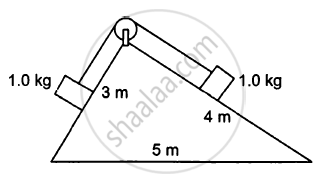
In the previous problem, suppose m2 = 2.0 kg and m3 = 3.0 kg. What should be the mass m, so that it remains at rest?
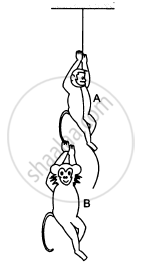
The monkey B, shown in the following figure, is holding on to the tail of monkey A that is climbing up a rope. The masses of monkeys A and B are 5 kg and 2 kg, respectively. If A can tolerate a tension of 30 N in its tail, what force should it apply on the rope in order to carry monkey B with it? Take g = 10 m/s2.
What do you understand by the term momentum?
