Advertisements
Advertisements
Question
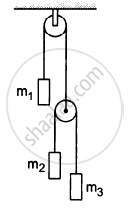
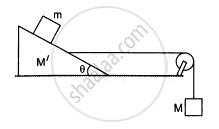
Let m1 = 1 kg, m2 = 2 kg and m3 = 3 kg in the following figure. Find the accelerations of m1, m2 and m3. The string from the upper pulley to m1 is 20 cm when the system is released from rest. How long will it take before m1 strikes the pulley?
Advertisements
Solution
The free-body diagram for mass m1 is shown below: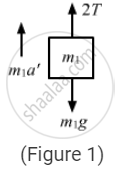 a
a
The free-body diagram for mass m2 is shown below: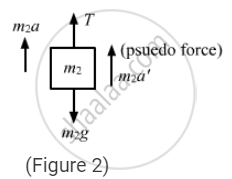
The free-body diagram for mass m3 is shown below: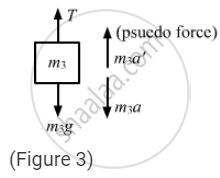
Suppose the block m1 moves upward with acceleration a1 and the blocks m2 and m3have relative acceleration a2 due to the difference of weight between them.
So, the actual acceleration of the blocks m1, m2 and m3 will be a1, (a1 − a2) and (a1 + a2), as shown.
From figure 2, T − 1g − 1a1 = 0 ...(i)
From figure 3,\[\frac{T}{2} - 2g - 2\left( a_1 - a_2 \right) = 0 . . . \left( ii \right)\]
From figure 4,\[\frac{T}{2} - 3g - 3\left( a_1 + a_2 \right) = 0 . . . \left( iii \right)\]
From equations (i) and (ii), eliminating T, we get:
1g + 1a2 = 4g + 4 (a1 + a2)
5a2 − 4a1 = 3g ...(iv)
From equations (ii) and (iii), we get:
2g + 2(a1 − a2) = 3g − 3 (a1 − a2)
5a1 + a2 = g ...(v)
Solving equations (iv) and (v), we get:
\[a_1 = \frac{2g}{29}\]
\[\text{ and }a_2 = g - 5 a_1 \]
\[ \Rightarrow a_2 = g - \frac{10g}{29} = \frac{19g}{29}\]
\[\text{So}, a_1 - a_2 = \frac{2g}{29} - \frac{19g}{29} = - \frac{17g}{29}\]
So, accelerations of m1, m2 and m3 are \[\frac{19g}{29}\left( up \right),
\frac{17g}{29} \left(\text{ down }\right)\text{ and }\frac{21g}{29}\left(\text{ down }\right)\]
Now, u = 0, s = 20 cm = 0.2 m
\[a_2 = \frac{19g}{29} \]
\[ \therefore s = ut + \frac{1}{2}a t^2 \]
\[ \Rightarrow 0 . 2 = \frac{1}{2} \times \frac{19}{29}g t^2 \]
\[ \Rightarrow t = 0 . 25 s\]
APPEARS IN
RELATED QUESTIONS
A rocket with a lift-off mass 20,000 kg is blasted upwards with an initial acceleration of 5.0 m s–2. Calculate the initial thrust (force) of the blast.
Explain why a cricketer moves his hands backwards while holding a catch.
An object is placed far away from all the objects that can exert force on it. A frame of reference is constructed by taking the origin and axes fixed in this object. Will the frame be necessarily inertial?
A smooth wedge A is fitted in a chamber hanging from a fixed ceiling near the earth's surface. A block B placed at the top of the wedge takes time T to slide down the length of the wedge. If the block is placed at the top of the wedge and the cable supporting the chamber is broken at the same instant, the block will.
The figure shows the displacement of a particle going along the X-axis as a function of time. The force acting on the particle is zero in the region
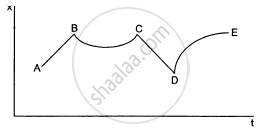
(a) AB
(b) BC
(c) CD
(d) DE
The force of buoyancy exerted by the atmosphere on a balloon is B in the upward direction and remains constant. The force of air resistance on the balloon acts opposite the direction of velocity and is proportional to it. The balloon carries a mass M and is found to fall to the earth's surface with a constant velocity v. How much mass should be removed from the balloon so that it may rise with a constant velocity v?
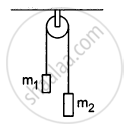
In a simple Atwood machine, two unequal masses m1 and m2 are connected by a string going over a clamped light smooth pulley. In a typical arrangement (In the following figure), m1 = 300 g and m2 = 600 g. The system is released from rest. (a) Find the distance travelled by the first block in the first two seconds; (b) find the tension in the string; (c) find the force exerted by the clamp on the pulley.
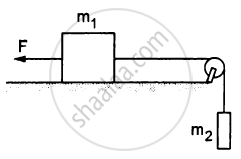
A constant force F = m2g/2 is applied on the block of mass m1 as shown in the following figure. The string and the pulley are light and the surface of the table is smooth. Find the acceleration of m1.
Find the acceleration of the block of mass M in the situation shown in the following figure. All the surfaces are frictionless and the pulleys and the string are light.
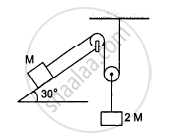
Find the mass M of the hanging block in the following figure that will prevent the smaller block from slipping over the triangular block. All the surfaces are frictionless and the strings and the pulleys are light.
A block is kept on the floor of an elevator at rest. The elevator starts descending with an acceleration of 12 m/s2. Find the displacement of the block during the first 0.2 s after the start. Take g = 10 m/s2.
An aeroplane is moving uniformly at a constant height under the action of two forces (i) Upward force (lift) and (ii) Downward force (weight). What is the net force on the aeroplane?
A force of 10 N acts on a body of mass 2 kg for 3 s, initially at rest. Calculate : Change in momentum of the body.
How long will a stone take to fall to the ground from the top of a building 80 m high
What do you understand by the term momentum?
Name the physical entity used for quantifying the motion of a body.
What do you mean by linear momentum of a body? A force causes an acceleration of 10 ms-2 in a body of mass 1 kg. What acceleration will be caused by the same force in a body of mass 4 kg?
A stone is dropped from a cliff 98 m high.
How long will it take to fall to the foot of the cliff?
A ball is thrown vertically downward with an initial velocity of 10 m/s. What is its speed 1 s later and 2 s later?
A metre scale is moving with uniform velocity. This implies ______.
