Advertisements
Advertisements
Question
A stone is dropped from a cliff 98 m high.
How long will it take to fall to the foot of the cliff?
Advertisements
Solution
Height of cliff = 98 m.
Initial velocity of stone = 0 ms-1.
Acceleration due to gravity = 9.8 ms-2.
We know H = ut + 1/2 gt2.
98 = 1/2 X 9.8X t2.
t2 = 98X2/9.8 = 20
t= 4.47 sec.
APPEARS IN
RELATED QUESTIONS
When a horse pulls a cart, the force that helps the horse to move forward is the force exerted by
If the tension in the cable supporting an elevator is equal to the weight of the elevator, the elevator may be
(a) going up with increasing speed
(b) going down with increasing speed
(c) going up with uniform speed
(d) going down with uniform speed
Two blocks of equal mass m are tied to each other through a light string. One of the blocks is pulled along the line joining them with a constant force F. Find the tension in the string joining the blocks.
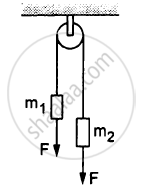
In the following figure, m1 = 5 kg, m2 = 2 kg and F = 1 N. Find the acceleration of either block. Describe the motion of m1 if the string breaks but F continues to act.
Two bodies A and B of same mass are moving with velocities v and 2v, respectively. Compare their (i) inertia and (ii) momentum.
Two balls A and B of masses m and 2 m are in motion with velocities 2v and v, respectively. Compare:
(i) Their inertia.
(ii) Their momentum.
(iii) The force needed to stop them in the same time.
Use Newton's second law of motion to explain the following instance :
An athlete prefers to land on sand instead of hard floor while taking a high jump .
A body of mass 5 kg is moving with velocity 2 m s-1. Calculate its linear momentum.
A ball is thrown vertically upwards. It returns 6 s later. Calculate the greatest height reached by the ball. (Take g = 10 m s−2)
Calculate the velocity of a body of mass 0.5 kg, when it has a linear momentum of 5 Ns.
