Advertisements
Advertisements
Question
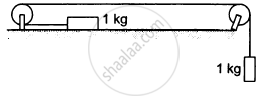
Calculate the tension in the string shown in the following figure. The pulley and the string are light and all the surfaces are frictionless. Take g = 10 m/s2.
Advertisements
Solution
The free-body diagrams for both the bodies are shown below: 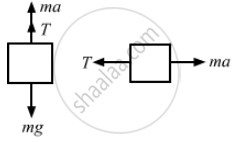
T + ma =mg ...(i)
and T = ma ...(ii)
From equations (i) and (ii), we get:
ma + ma = mg
⇒ 2ma = g
\[\Rightarrow a = \frac{g}{2} = \frac{10}{5} = 5 m/ s^2\]
From equation (ii),
T = ma = 5 N
APPEARS IN
RELATED QUESTIONS
A batsman deflects a ball by an angle of 45° without changing its initial speed which is equal to 54 km/h. What is the impulse imparted to the ball? (Mass of the ball is 0.15 kg.)
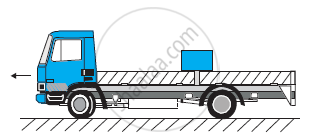
The rear side of a truck is open and a box of 40 kg mass is placed 5 m away from the open end as shown in Figure. The coefficient of friction between the box and the surface below it is 0.15. On a straight road, the truck starts from rest and accelerates with 2 m s–2. At what distance from the starting point does the box fall off the truck? (Ignore the size of the box).
You are travelling in a car. The driver suddenly applies the brakes and you are pushed forward. Why does this happen?
An object is placed far away from all the objects that can exert force on it. A frame of reference is constructed by taking the origin and axes fixed in this object. Will the frame be necessarily inertial?
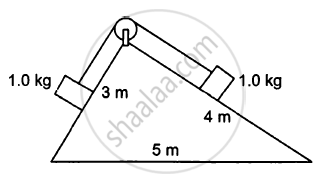
Consider the situation shown in the following figure All the surfaces are frictionless and the string and the pulley are light. Find the magnitude of acceleration of the two blocks.
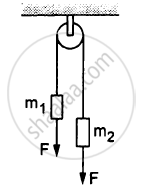
In the following figure, m1 = 5 kg, m2 = 2 kg and F = 1 N. Find the acceleration of either block. Describe the motion of m1 if the string breaks but F continues to act.
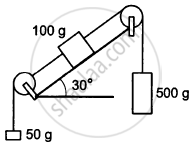
Find the acceleration of the 500 g block in the following figure.
A block is kept on the floor of an elevator at rest. The elevator starts descending with an acceleration of 12 m/s2. Find the displacement of the block during the first 0.2 s after the start. Take g = 10 m/s2.
Two balls A and B of masses m and 2 m are in motion with velocities 2v and v, respectively. Compare:
(i) Their inertia.
(ii) Their momentum.
(iii) The force needed to stop them in the same time.
The unit of linear momentum is :
A car is moving with a uniform velocity 30 ms-1. It is stopped in 2 s by applying a force of 1500 N through its brakes. Calculate the following values : The change in momentum of car.
A pebble is dropped freely in a well from its top. It takes 20 s for the pebble to reach the water surface in the well. Taking g = 10 m s-2 and speed of sound = 330 m s-1. Find : The time when echo is heard after the pebble is dropped.
Calculate the velocity of a body of mass 0.5 kg, when it has a linear momentum of 5 Ns.
What do you understand by the term momentum?
Name the physical entity used for quantifying the motion of a body.
What do you mean by an impulsive force?
Use Newton's second law to explain the following:
We always prefer to land on sand instead of hard floor while taking a high jump.
According to Newton's Second Law of Motion, what quantity is directly proportional to the applied force?
How does moving your hand backward while catching a cricket ball reduce pain?
