Newton’s Second Law corrected the old belief that force is needed to maintain motion. This idea came from the philosopher ______.
Advertisements
Advertisements
Question
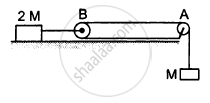
Consider the situation shown in the following figure. Both the pulleys and the string are light and all the surfaces are frictionless.
- Find the acceleration of the mass M.
- Find the tension in the string.
- Calculate the force exerted by the clamp on the pulley A in the figure.
Sum
Advertisements
Solution
Let the acceleration of mass M be a.
So, the acceleration of mass 2M will be \[\frac{a}{2}\]
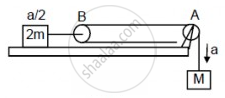
(a)
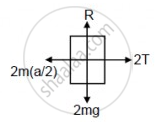
2M(a/2) − 2T = 0
⇒ Ma = 2T
T + Ma − Mg = 0
\[\Rightarrow \frac{Ma}{2} + Ma = Mg \]
\[ \Rightarrow 3Ma = 2Mg\]
\[ \Rightarrow a = \frac{2g}{3}\]
(b) Tension,
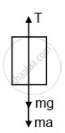
\[T = \frac{Ma}{2} = \frac{M}{2} \times \frac{2g}{3} = \frac{Mg}{3}\]
(c)
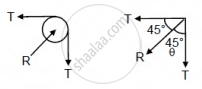
Let T' = resultant of tensions
\[\therefore T' = \sqrt{T^2 + T^2} = \sqrt{2}T\]
\[ \therefore T' = \sqrt{2}T = \frac{\sqrt{2}Mg}{3}\]
\[\text{Again, }\tan\theta = \frac{T}{T} = 1\]
\[ \Rightarrow \theta = 45^\circ\]
So, it is `(sqrt2"Mg")/3` at an angle of 45° with the horizontal.
That is the force exerted by the clamp.
shaalaa.com
Is there an error in this question or solution?
APPEARS IN
RELATED QUESTIONS
Two masses 8 kg and 12 kg are connected at the two ends of a light, inextensible string that goes over a frictionless pulley. Find the acceleration of the masses, and the tension in the string when the masses are released.
A car accelerates on a horizontal road due to the force exerted by.
A block of mass 0.2 kg is suspended from the ceiling by a light string. A second block of mass 0.3 kg is suspended from the first block by another string. Find the tensions in the two strings. Take g = 10 m/s2.
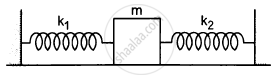
Both the springs shown in the following figure are unstretched. If the block is displaced by a distance x and released, what will be the initial acceleration?
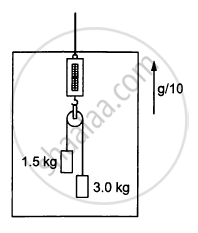
Find the reading of the spring balance shown in the following figure. The elevator is going up with an acceleration g/10, the pulley and the string are light and the pulley is smooth.
Calculate the tension in the string shown in the following figure. The pulley and the string are light and all the surfaces are frictionless. Take g = 10 m/s2.
A block is kept on the floor of an elevator at rest. The elevator starts descending with an acceleration of 12 m/s2. Find the displacement of the block during the first 0.2 s after the start. Take g = 10 m/s2.
An aeroplane is moving uniformly at a constant height under the action of two forces (i) Upward force (lift) and (ii) Downward force (weight). What is the net force on the aeroplane?
Show that the rate of change of momentum = mass × acceleration. Under what condition does this relation hold?
State the Newton's second law of motion. What information do you get from it?
The correct form of Newton's second law is :
State the magnitude and direction of the force of gravity acting on the body of mass 5 kg. Take g = 9.8 m s-2.
Multiple Choice Question. Select the correct option.
Which of the following are vector quantities?
ame the law of motion which gives the definition of force.
What causes motion in a body?
Use Newton's second law to explain the following:
We always prefer to land on sand instead of hard floor while taking a high jump.
Use Newton's second law to explain the following:
While catching a fast moving ball, we always pull our hands backwards.
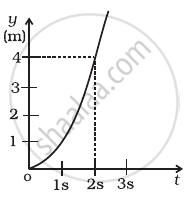
Figure shows (x, t), (y, t ) diagram of a particle moving in 2-dimensions.
|
|
 (b) |
If the particle has a mass of 500 g, find the force (direction and magnitude) acting on the particle.
What happens when a car brakes to come to a stop?
