Advertisements
Advertisements
Question
Two masses 8 kg and 12 kg are connected at the two ends of a light, inextensible string that goes over a frictionless pulley. Find the acceleration of the masses, and the tension in the string when the masses are released.
Advertisements
Solution
The given system of two masses and a pulley can be represented as shown in the following figure:
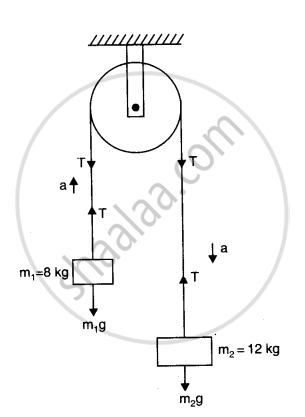
Smaller mass, m1 = 8 kg
Larger mass, m2 = 12 kg
Tension in the string = T
Mass m2, owing to its weight, moves downward with acceleration a,and mass m1moves upward.
Applying Newton’s second law of motion to the system of each mass:
For mass m1:
The equation of motion can be written as:
T – m1g = ma … (i)
For mass m2:
The equation of motion can be written as:
m2g – T = m2a … (ii)
Adding equations (i) and (ii), we get:
(m_2-m_1)g = (m_1+ m_2)a
`:.a = ((m_2-m_1)/(m_1+m_2))g ...(iii)`
`=((12-8)/(12+8)) xx 10= 4/20 xx 10 = 2 "m/s"^2`
Therefore, the acceleration of the masses is 2 m/s2.
Substituting the value of a in equation (ii), we get:
`m_2g - T = m_2 ( (m_2-m_1)/(m_1+m_2))g`
`=((2m_1m_2)/(m_1+m_2))g`
`=(2xx12xx8)/(12+8)xx10`
`=(2xx12xx8)/20 xx 10 = 96 N`
Therefore, the tension in the string is 96 N.
APPEARS IN
RELATED QUESTIONS
An object is placed far away from all the objects that can exert force on it. A frame of reference is constructed by taking the origin and axes fixed in this object. Will the frame be necessarily inertial?
A block of mass m is placed on a smooth wedge of inclination θ. The whole system is accelerated horizontally so that the block does not slip on the wedge. The force exerted by the wedge on the block has a magnitude.
The figure shows the displacement of a particle going along the X-axis as a function of time. The force acting on the particle is zero in the region
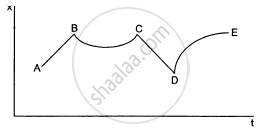
(a) AB
(b) BC
(c) CD
(d) DE
A person says that he measured the acceleration of a particle to be non-zero even though no force was acting on the particle.
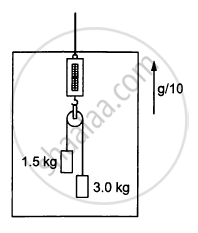
Find the reading of the spring balance shown in the following figure. The elevator is going up with an acceleration g/10, the pulley and the string are light and the pulley is smooth.
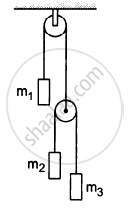
Let m1 = 1 kg, m2 = 2 kg and m3 = 3 kg in the following figure. Find the accelerations of m1, m2 and m3. The string from the upper pulley to m1 is 20 cm when the system is released from rest. How long will it take before m1 strikes the pulley?
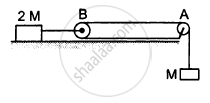
Consider the situation shown in the following figure. Both the pulleys and the string are light and all the surfaces are frictionless.
- Find the acceleration of the mass M.
- Find the tension in the string.
- Calculate the force exerted by the clamp on the pulley A in the figure.
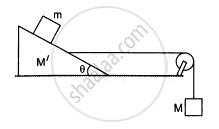
Find the mass M of the hanging block in the following figure that will prevent the smaller block from slipping over the triangular block. All the surfaces are frictionless and the strings and the pulleys are light.
Use Newton's second law of motion to explain the following instance :
An athlete prefers to land on sand instead of hard floor while taking a high jump .
Calculate the magnitude of force which when applied on a body of mass 0.5 kg produces an acceleration of 5 m s-2.
A force acts for 10 s on a stationary body of mass 100 kg, after which the force ceases to act. The body moves through a distance of 100 m in the next 5 s. Calculate : The magnitude of the force
How long will a stone take to fall to the ground from the top of a building 80 m high
State two factors which determine the momentum of a body.
Define Newton’s second law of motion.
Multiple Choice Question. Select the correct option.
The impulse of a body is equal to:
Multiple Choice Question. Select the correct option.
A force acts on a body of mass 3 kg such that its velocity changes from 4 ms−1 to 10 ms−1. The change in momentum of the body is
Use Newton's second law to explain the following:
We always prefer to land on sand instead of hard floor while taking a high jump.
A ball is thrown vertically downward with an initial velocity of 10 m/s. What is its speed 1 s later and 2 s later?
What do you mean by the conservation of momentum? Briefly, explain the collision between two bodies and the conservation of momentum.
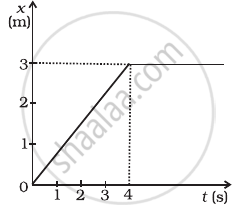
The position time graph of a body of mass 2 kg is as given in figure. What is the impulse on the body at t = 0 s and t = 4 s.