Advertisements
Advertisements
Question
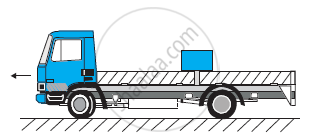
The rear side of a truck is open and a box of 40 kg mass is placed 5 m away from the open end as shown in Figure. The coefficient of friction between the box and the surface below it is 0.15. On a straight road, the truck starts from rest and accelerates with 2 m s–2. At what distance from the starting point does the box fall off the truck? (Ignore the size of the box).
Advertisements
Solution 1
Force experienced by box, F = ma = 40 x 2 = 80 N
Frictional force `F_f = mu mg` = 0.15 x 40 x 10 = 60 N.
Backward acceleration produced in the box, `a =20/40("Net Force")/m`
`=>a = 0.5 "ms"^(-2)`
if t is time taken by the box to travel s =5 metre and fall off the truck, then from
`S = ut + 1/2 at^2`
`5 = 0 xx t + 1/2 xx 0.5 t^2`
`t= sqrt((5xx2)/0.5) = 4.47 s`
if the truck travel a distace x during this time, then again from
`S = ut + 1/2 at^2`
`x = 0 xx 4.47 + 1/2 xx 2(4.47)^2 = 19.98 m`
Solution 2
Mass of the box, m = 40 kg
Coefficient of friction, μ = 0.15
Initial velocity, u = 0
Acceleration, a = 2 m/s2
Distance of the box from the end of the truck, s' = 5 m
As per Newton’s second law of motion, the force on the box caused by the accelerated motion of the truck is given by: F = ma
= 40 × 2 = 80 N
As per Newton’s third law of motion, a reaction force of 80 N is acting on the box in the backward direction. The backward motion of the box is opposed by the force of friction f, acting between the box and the floor of the truck. This force is given by:
f = μmg
= 0.15 × 40 × 10 = 60 N
∴Net force acting on the block:
Fnet = 80 – 60 = 20 N backward
The backward acceleration produced in the box is given by:
`a_"back" = F_"net"/m = 20/ 4 = 0.5 "m/s"^2`
Using the second equation of motion, time t can be calculated as:
`s' = ut + 1/2 a_"back" t^2`
`5 = 0 + 1/2 xx 0.5 xx t^2`
`:.t = sqrt20 s`
Hence, the box will fall from the truck after `sqrt20 s` from start
The distance s, travelled by the truck in `sqrt20 s` is given by the relation:
`s = ut + 1/2 at^2`
`=0 + 1/2xx2 xx(sqrt20)^2`
= 20 m
RELATED QUESTIONS
A constant retarding force of 50 N is applied to a body of mass 20 kg moving initially with a speed of 15 ms–1. How long does the body take to stop?
A rocket with a lift-off mass 20,000 kg is blasted upwards with an initial acceleration of 5.0 m s–2. Calculate the initial thrust (force) of the blast.
A block of mass m is placed on a smooth wedge of inclination θ. The whole system is accelerated horizontally so that the block does not slip on the wedge. The force exerted by the wedge on the block has a magnitude.
If the tension in the cable supporting an elevator is equal to the weight of the elevator, the elevator may be
(a) going up with increasing speed
(b) going down with increasing speed
(c) going up with uniform speed
(d) going down with uniform speed
A person says that he measured the acceleration of a particle to be non-zero even though no force was acting on the particle.
Two blocks of equal mass m are tied to each other through a light string. One of the blocks is pulled along the line joining them with a constant force F. Find the tension in the string joining the blocks.
A particle of mass 0.3 kg is subjected to a force F = −kx with k = 15 N/m. What will be its initial acceleration if it is released from a point x = 20 cm?
The force of buoyancy exerted by the atmosphere on a balloon is B in the upward direction and remains constant. The force of air resistance on the balloon acts opposite the direction of velocity and is proportional to it. The balloon carries a mass M and is found to fall to the earth's surface with a constant velocity v. How much mass should be removed from the balloon so that it may rise with a constant velocity v?
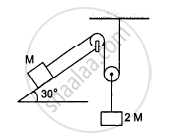
Find the acceleration of the block of mass M in the situation shown in the following figure. All the surfaces are frictionless and the pulleys and the string are light.
Show that the rate of change of momentum = mass × acceleration. Under what condition does this relation hold?
State the Newton's second law of motion. What information do you get from it?
A body of mass 5 kg is moving with velocity 2 m s-1. Calculate its linear momentum.
How long will a stone take to fall to the ground from the top of a building 80 m high
Multiple Choice Question. Select the correct option.
The impulse of a body is equal to:
Which of the following has the largest inertia?
Name the physical quantity which equals the rate of change of linear momentum.
Use Newton's second law to explain the following:
We always prefer to land on sand instead of hard floor while taking a high jump.
The INCORRECT statement about Newton's second law of motion is
A metre scale is moving with uniform velocity. This implies ______.
What happens when a car brakes to come to a stop?
