Advertisements
Advertisements
Question
A stone of mass m tied to the end of a string revolves in a vertical circle of radius R. The net forces at the lowest and highest points of the circle directed vertically downwards are: [Choose the correct alternative]
| Lowest Point | Highest Point | |
| a) | mg – T1 | mg + T2 |
| b) | mg + T1 | mg – T2 |
| c) | `mg + T1 –(m_v_1^2)/R` | mg – T2 + (`mv_1^2`)/R |
| d) | `mg – T1 – (mv)/R` | mg + T2 + (mv_1^2)/R |
T1 and v1 denote the tension and speed at the lowest point. T2 and v2 denote corresponding values at the highest point.
Advertisements
Solution 1
(a)The free body diagram of the stone at the lowest point is shown in the following figure.
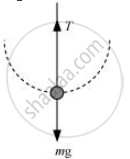
According to Newton’s second law of motion, the net force acting on the stone at this point is equal to the centripetal force, i.e.,
`F_"net" = T - mg = (mv_1^2)/R ...(i)`
Where, v1 = Velocity at the lowest point
The free body diagram of the stone at the highest point is shown in the following figure
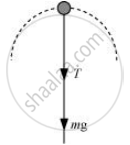
Using Newton’s second law of motion, we have:
`T + mg = (mv_2^2)/R `...(ii)
Where, v2 = Velocity at the highest point
It is clear from equations (i) and (ii) that the net force acting at the lowest and the highest points are respectively (T – mg) and (T + mg).
Solution 2
The net force at the lowest point is (mg – T1) and the net force at the highest point is (mg + T2). Therefore, alternative (a) is correct. Since mg and T1 are in mutually opposite directions at lowest point and mg and T2are in same direction at the highest point.
RELATED QUESTIONS
Explain why a cricketer moves his hands backwards while holding a catch.
When a horse pulls a cart, the force that helps the horse to move forward is the force exerted by
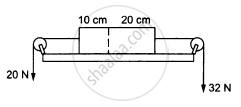
In the following figure shows a uniform rod of length 30 cm and mass 3.0 kg. The strings shown in the figure are pulled by constant forces of 20 N and 32 N. Find the force exerted by the 20 cm part of the rod on the 10 cm part. All the surfaces are smooth and the strings and the pulleys are light.
In the previous problem, suppose m2 = 2.0 kg and m3 = 3.0 kg. What should be the mass m, so that it remains at rest?
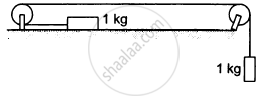
Calculate the tension in the string shown in the following figure. The pulley and the string are light and all the surfaces are frictionless. Take g = 10 m/s2.
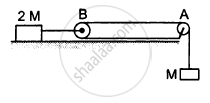
Consider the situation shown in the following figure. Both the pulleys and the string are light and all the surfaces are frictionless.
- Find the acceleration of the mass M.
- Find the tension in the string.
- Calculate the force exerted by the clamp on the pulley A in the figure.
Two balls A and B of masses m and 2 m are in motion with velocities 2v and v, respectively. Compare:
(i) Their inertia.
(ii) Their momentum.
(iii) The force needed to stop them in the same time.
Calculate the magnitude of force which when applied on a body of mass 0.5 kg produces an acceleration of 5 m s-2.
A force acts for 10 s on a stationary body of mass 100 kg, after which the force ceases to act. The body moves through a distance of 100 m in the next 5 s. Calculate : The magnitude of the force
How long will a stone take to fall to the ground from the top of a building 80 m high
Calculate the velocity of a body of mass 0.5 kg, when it has a linear momentum of 5 Ns.
An electron of mass 9 × 10⁻³¹ kg is moving with a linear velocity of 6 × 10⁷ ms−1. Calculate the linear momentum of electron.
Name the physical entity used for quantifying the motion of a body.
Which of the following has the largest inertia?
State Newton's second law of motion. Is Newton's first law of motion contained in Newton's second law of motion?
What do you mean by an impulsive force?
Use Newton's second law to explain the following:
While catching a fast moving ball, we always pull our hands backwards.
A ball is thrown vertically downward with an initial velocity of 10 m/s. What is its speed 1 s later and 2 s later?
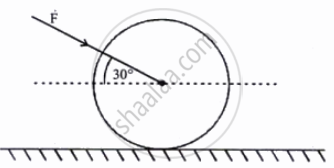
As shown in figure, a 70 kg garden roller is pushed with a force of F = 200 N at an angle of 30° with horizontal. The normal reaction on the roller is: (Given: g = 10 ms−2)