Advertisements
Advertisements
Question
An aircraft executes a horizontal loop at a speed of 720 km/h with its wings banked at 15°. What is the radius of the loop?
Advertisements
Solution 1
Here v = 720 km/h = `720xx 5/18` m/s = 200 m/s and angle of banking `theta = 15^@`
From the relation
`tan theta = v^2/"rg"` we have
`r = v^2/(g tan theta) = (200xx200) /(10 xx tan 15^@) = (200xx200)/(10xx0.2679)`
=> r = 14931 m = 14.9 km
Solution 2
Speed of the aircraft, v = 720 km/h = `720xx5/18 = 200` m/s
Acceleration due to gravity, g = 10 m/s2
Angle of banking, θ = 15°
For radius r, of the loop, we have the relation:
`tan theta = v^2/"rg"`
`r = v^2/(g tan theta)`
`= (200xx200)/(10xx tan 15) = 4000/0.268`
= 14925.37 m
= 14.92 km
RELATED QUESTIONS
Two masses 8 kg and 12 kg are connected at the two ends of a light, inextensible string that goes over a frictionless pulley. Find the acceleration of the masses, and the tension in the string when the masses are released.
A person drops a coin. Describe the path of the coin as seen by the person if he is in
- a car moving at constant velocity and
- in a free falling elevator.
You are travelling in a car. The driver suddenly applies the brakes and you are pushed forward. Why does this happen?
A car accelerates on a horizontal road due to the force exerted by.
A smooth wedge A is fitted in a chamber hanging from a fixed ceiling near the earth's surface. A block B placed at the top of the wedge takes time T to slide down the length of the wedge. If the block is placed at the top of the wedge and the cable supporting the chamber is broken at the same instant, the block will.
The force of buoyancy exerted by the atmosphere on a balloon is B in the upward direction and remains constant. The force of air resistance on the balloon acts opposite the direction of velocity and is proportional to it. The balloon carries a mass M and is found to fall to the earth's surface with a constant velocity v. How much mass should be removed from the balloon so that it may rise with a constant velocity v?
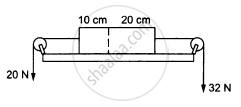
In the following figure shows a uniform rod of length 30 cm and mass 3.0 kg. The strings shown in the figure are pulled by constant forces of 20 N and 32 N. Find the force exerted by the 20 cm part of the rod on the 10 cm part. All the surfaces are smooth and the strings and the pulleys are light.
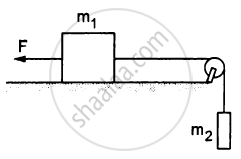
A constant force F = m2g/2 is applied on the block of mass m1 as shown in the following figure. The string and the pulley are light and the surface of the table is smooth. Find the acceleration of m1.
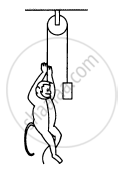
A monkey is climbing on a rope that goes over a smooth light pulley and supports a block of equal mass at the other end in the following figure. Show that whatever force the monkey exerts on the rope, the monkey and the block move in the same direction with equal acceleration. If initially both were at rest, their separation will not change as time passes.
Two balls A and B of masses m and 2 m are in motion with velocities 2v and v, respectively. Compare:
(i) Their inertia.
(ii) Their momentum.
(iii) The force needed to stop them in the same time.
The linear momentum of a body of mass m moving with velocity v is :
The linear momentum of a ball of mass 50 g is 0.5 kg m s-1. Find its velocity.
A pebble is dropped freely in a well from its top. It takes 20 s for the pebble to reach the water surface in the well. Taking g = 10 m s-2 and speed of sound = 330 m s-1. Find : The time when echo is heard after the pebble is dropped.
State two factors which determine the momentum of a body.
Which of the following has the largest inertia?
The INCORRECT statement about Newton's second law of motion is
In the previous problem (5.3), the magnitude of the momentum transferred during the hit is ______.
A woman throws an object of mass 500 g with a speed of 25 ms1.
- What is the impulse imparted to the object?
- If the object hits a wall and rebounds with half the original speed, what is the change in momentum of the object?
According to Newton's Second Law of Motion, what quantity is directly proportional to the applied force?
What happens when a car brakes to come to a stop?
