Advertisements
Advertisements
Question
Multiple Choice Question. Select the correct option.
The impulse of a body is equal to:
Options
(a) rate of change of its momentum
(b) change in its momentum
(c) the product of force applied on it and the time of application of force.
(d) both (b) and (c)
Advertisements
Solution
(d) both (b) and (c)
APPEARS IN
RELATED QUESTIONS
A man of mass 70 kg stands on a weighing scale in a lift which is moving
- upwards with a uniform speed of 10 m s-1
- downwards with a uniform acceleration of 5 m s–2
- upwards with a uniform acceleration of 5 m s–2. What would be the readings on the scale in each case?
- What would be the reading if the lift mechanism failed and it hurtled down freely under gravity?
A smooth wedge A is fitted in a chamber hanging from a fixed ceiling near the earth's surface. A block B placed at the top of the wedge takes time T to slide down the length of the wedge. If the block is placed at the top of the wedge and the cable supporting the chamber is broken at the same instant, the block will.
In a TV picture tube, electrons are ejected from the cathode with negligible speed and they attain a velocity of 5 × 10⁶ m/s in travelling one centimetre. Assuming straight-line motion, find the constant force exerted on the electrons. The mass of an electron is 9.1 × 10⁻³¹ kg.
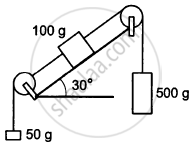
Find the acceleration of the 500 g block in the following figure.
The linear momentum of a body of mass m moving with velocity v is :
A force of 10 N acts on a body of mass 2 kg for 3 s, initially at rest. Calculate : Change in momentum of the body.
Define Newton’s second law of motion.
ame the law of motion which gives the definition of force.
A stone is thrown vertically upward with a velocity of 9.8 m/s. When will it reach the ground?
Why does a child feel more pain when she falls down on a hard cement floor, than when she falls on the soft muddy ground in the garden?
