Advertisements
Advertisements
Question
A metre scale is moving with uniform velocity. This implies ______.
Options
the force acting on the scale is zero, but a torque about the centre of mass can act on the scale.
the force acting on the scale is zero and the torque acting about centre of mass of the scale is also zero.
the total force acting on it need not be zero but the torque on it is zero.
neither the force nor the torque need to be zero.
Advertisements
Solution
A metre scale is moving with uniform velocity. This implies the force acting on the scale is zero and the torque acting about centre of mass of the scale is also zero.
Explanation:
Since the body is moving with a uniform velocity, hence its acceleration is zero. This implies that the net force acting on it must be zero, which further makes the torque acting about the centre of mass of the scale also zero.
APPEARS IN
RELATED QUESTIONS
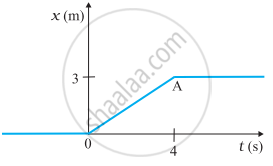
The below figure shows the position-time graph of a particle of mass 4 kg.
- What is the force on the particle for t < 0, t > 4 s, 0 < t < 4 s?
- What is the impulse at t = 0 and t = 4 s? (Consider one-dimensional motion only.)
A helicopter of mass 1000 kg rises with a vertical acceleration of 15 m s–2. The crew and the passengers weigh 300 kg. Give the magnitude and direction of the
(a) force on the floor by the crew and passengers,
(b) action of the rotor of the helicopter on the surrounding air,
(c) force on the helicopter due to the surrounding air.
You are travelling in a car. The driver suddenly applies the brakes and you are pushed forward. Why does this happen?
Two objects A and B are thrown upward simultaneously with the same speed. The mass of A is greater than that of B. Suppose the air exerts a constant and equal force of resistance on the two bodies.
A particle of mass 0.3 kg is subjected to a force F = −kx with k = 15 N/m. What will be its initial acceleration if it is released from a point x = 20 cm?
Suppose the ceiling in the previous problem is that of an elevator which is going up with an acceleration of 2.0 m/s2. Find the elongation.
In the previous problem, suppose m2 = 2.0 kg and m3 = 3.0 kg. What should be the mass m, so that it remains at rest?
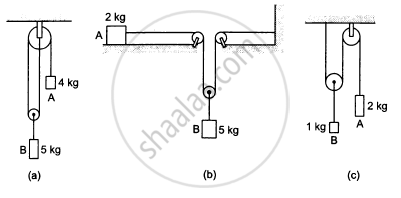
Find the acceleration of the blocks A and B in the three situations shown in the following figure.
Show that the rate of change of momentum = mass × acceleration. Under what condition does this relation hold?
Use Newton's second law of motion to explain the following instance :
An athlete prefers to land on sand instead of hard floor while taking a high jump .
State the magnitude and direction of the force of gravity acting on the body of mass 5 kg. Take g = 9.8 m s-2.
A pebble is dropped freely in a well from its top. It takes 20 s for the pebble to reach the water surface in the well. Taking g = 10 m s-2 and speed of sound = 330 m s-1. Find : The depth of water surface
Multiple Choice Question. Select the correct option.
A force acts on a body of mass 3 kg such that its velocity changes from 4 ms−1 to 10 ms−1. The change in momentum of the body is
Use Newton's second law to explain the following:
While catching a fast moving ball, we always pull our hands backwards.
A ball is thrown upward and reaches a maximum height of 19.6 m. Find its initial speed?
A stone is dropped from a tower 98 m high. With what speed should a second stone be thrown 1 s later so that both hit the ground at the same time?
A body of mass 2 kg travels according to the law x(t) = pt + qt2 + rt3 where p = 3 ms−1, q = 4 ms−2 and r = 5 ms−3. The force acting on the body at t = 2 seconds is ______.
A woman throws an object of mass 500 g with a speed of 25 ms1.
- What is the impulse imparted to the object?
- If the object hits a wall and rebounds with half the original speed, what is the change in momentum of the object?
Why is catching a slow-moving ball easier than catching a fast-moving ball?
