Advertisements
Advertisements
Question
Calculate the velocity of a body of mass 0.5 kg, when it has a linear momentum of 5 Ns.
Advertisements
Solution
Mass of body = m = 0.5 kg
Linear momentum = P = 5 Ns
Velocity of body = v = ?
We know P = mv
v = `"P"/"m"=5/0.5`
v = 10 ms−1
APPEARS IN
RELATED QUESTIONS
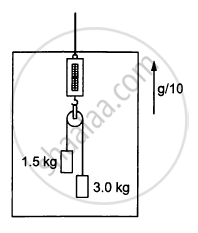
Find the reading of the spring balance shown in the following figure. The elevator is going up with an acceleration g/10, the pulley and the string are light and the pulley is smooth.
In the previous problem, suppose m2 = 2.0 kg and m3 = 3.0 kg. What should be the mass m, so that it remains at rest?
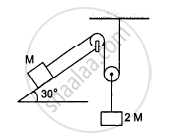
Find the acceleration of the block of mass M in the situation shown in the following figure. All the surfaces are frictionless and the pulleys and the string are light.
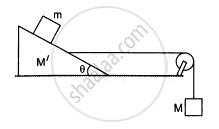
Find the mass M of the hanging block in the following figure that will prevent the smaller block from slipping over the triangular block. All the surfaces are frictionless and the strings and the pulleys are light.
A monkey of mass 15 kg is climbing a rope fixed to a ceiling. If it wishes to go up with an acceleration of 1 m/s2, how much force should it apply on the rope? If the rope is 5 m long and the monkey starts from rest, how much time will it take to reach the ceiling?
A force of 10 N acts on a body of mass 2 kg for 3 s, initially at rest. Calculate : Change in momentum of the body.
A pebble is thrown vertically upwards with a speed of 20 m s-1. How high will it be after 2 s? (Take g = 10 m s-2)
What do you understand by the term momentum?
Name the physical entity used for quantifying the motion of a body.
In the previous problem (5.3), the magnitude of the momentum transferred during the hit is ______.
