Advertisements
Advertisements
Question
An electron of mass 9 × 10⁻³¹ kg is moving with a linear velocity of 6 × 10⁷ ms−1. Calculate the linear momentum of electron.
Advertisements
Solution
Mass of electron = m = 9 × 10⁻³¹ kg
Velocity of electron = v = 6 × 10⁷ ms−1
Momentum of electron = P = ?
We know, P = mv
P = 9.1 × 10−31 × 6 × 107
P = 54 × 10−24 kg ms−1 or Ns
= 54 × 10−24 kg ms−1 Ns
APPEARS IN
RELATED QUESTIONS
The figure shows the displacement of a particle going along the X-axis as a function of time. The force acting on the particle is zero in the region
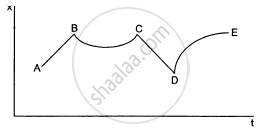
(a) AB
(b) BC
(c) CD
(d) DE
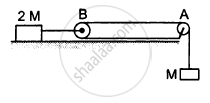
Consider the situation shown in the following figure. Both the pulleys and the string are light and all the surfaces are frictionless.
- Find the acceleration of the mass M.
- Find the tension in the string.
- Calculate the force exerted by the clamp on the pulley A in the figure.
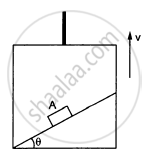
A block A can slide on a frictionless incline of angle θ and length l, kept inside an elevator going up with uniform velocity v in the following figure. Find the time taken by the block to slide down the length of the incline if it is released from the top of the incline.
A car is moving with a uniform velocity 30 ms-1. It is stopped in 2 s by applying a force of 1500 N through its brakes. Calculate the following values : The change in momentum of car.
A bullet of mass 50 g moving with an initial velocity 100 m s-1 strikes a wooden block and comes to rest after penetrating a distance 2 cm in it. Calculate: (i) Initial momentum of the bullet, (ii) Final momentum of the bullet, (iii) Retardation caused by the wooden block and (iv) Resistive force exerted by the wooden block.
State the magnitude and direction of the force of gravity acting on the body of mass 5 kg. Take g = 9.8 m s-2.
Prove mathematically F = ma
ame the law of motion which gives the definition of force.
In the previous problem (5.3), the magnitude of the momentum transferred during the hit is ______.
According to Newton's Second Law of Motion, what quantity is directly proportional to the applied force?
