Advertisements
Advertisements
Question
State the magnitude and direction of the force of gravity acting on the body of mass 5 kg. Take g = 9.8 m s-2.
Advertisements
Solution
Mass = 5 kg.
g = 9.8 m/s2.
Let F be the force of gravity,
F = mg.
F = (5) (9.8) = 49 N.
Force of gravity always acts downwards.
APPEARS IN
RELATED QUESTIONS
A smooth wedge A is fitted in a chamber hanging from a fixed ceiling near the earth's surface. A block B placed at the top of the wedge takes time T to slide down the length of the wedge. If the block is placed at the top of the wedge and the cable supporting the chamber is broken at the same instant, the block will.
In a TV picture tube, electrons are ejected from the cathode with negligible speed and they attain a velocity of 5 × 10⁶ m/s in travelling one centimetre. Assuming straight-line motion, find the constant force exerted on the electrons. The mass of an electron is 9.1 × 10⁻³¹ kg.
Consider the situation shown in the following figure. Both the pulleys and the string are light and all the surfaces are frictionless.
- Find the acceleration of the mass M.
- Find the tension in the string.
- Calculate the force exerted by the clamp on the pulley A in the figure.
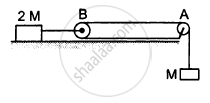
Find the acceleration of the block of mass M in the situation shown in the following figure. All the surfaces are frictionless and the pulleys and the string are light.
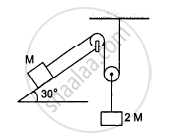
Find the mass M of the hanging block in the following figure that will prevent the smaller block from slipping over the triangular block. All the surfaces are frictionless and the strings and the pulleys are light.
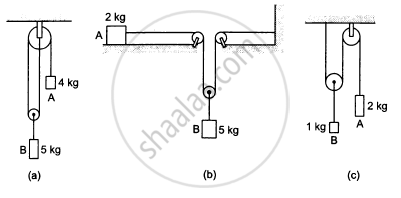
Find the acceleration of the blocks A and B in the three situations shown in the following figure.
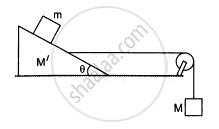
Multiple Choice Question. Select the correct option.
A force acts on a body of mass 3 kg such that its velocity changes from 4 ms−1 to 10 ms−1. The change in momentum of the body is
State Newton's second law of motion. Is Newton's first law of motion contained in Newton's second law of motion?
A body of mass 2 kg travels according to the law x(t) = pt + qt2 + rt3 where p = 3 ms−1, q = 4 ms−2 and r = 5 ms−3. The force acting on the body at t = 2 seconds is ______.
Why is catching a slow-moving ball easier than catching a fast-moving ball?
