Advertisements
Advertisements
Question
In a TV picture tube, electrons are ejected from the cathode with negligible speed and they attain a velocity of 5 × 10⁶ m/s in travelling one centimetre. Assuming straight-line motion, find the constant force exerted on the electrons. The mass of an electron is 9.1 × 10⁻³¹ kg.
Advertisements
Solution
Initial velocity of the electrons is negligible, i.e. u = 0.
Final velocity of the electrons, v = 5 × 10⁶ m/s
Distance travelled by the electrons,
s = 1 cm = 1 × 10⁻² m
∴ Acceleration, \[a = \frac{v^2 - u^2}{2 S}\]
\[\Rightarrow a = \frac{\left( 5 \times {10}^5 \right)^2 - 0}{2 \times 1 \times {10}^{- 3}} = \frac{25 \times {10}^{12}}{2 \times {10}^{- 2}}\]
So, force on the electrons, F = ma
⇒ F = 9.1 × 10−31 × 12.5 × 10−14
= 1.1 × 10⁻¹⁵ N
APPEARS IN
RELATED QUESTIONS
A constant retarding force of 50 N is applied to a body of mass 20 kg moving initially with a speed of 15 ms–1. How long does the body take to stop?
An aircraft executes a horizontal loop at a speed of 720 km/h with its wings banked at 15°. What is the radius of the loop?
A spy jumps from an airplane with his parachute. The spy accelerates downward for some time when the parachute opens. The acceleration is suddenly checked and the spy slowly falls to the ground. Explain the action of the parachute in checking the acceleration.
A block of mass m is placed on a smooth wedge of inclination θ. The whole system is accelerated horizontally so that the block does not slip on the wedge. The force exerted by the wedge on the block has a magnitude.
The figure shows the displacement of a particle going along the X-axis as a function of time. The force acting on the particle is zero in the region
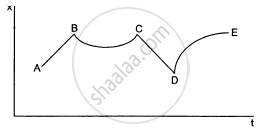
(a) AB
(b) BC
(c) CD
(d) DE
A person says that he measured the acceleration of a particle to be non-zero even though no force was acting on the particle.
In the previous problem, suppose m2 = 2.0 kg and m3 = 3.0 kg. What should be the mass m, so that it remains at rest?
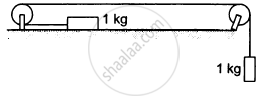
Calculate the tension in the string shown in the following figure. The pulley and the string are light and all the surfaces are frictionless. Take g = 10 m/s2.
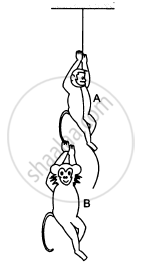
The monkey B, shown in the following figure, is holding on to the tail of monkey A that is climbing up a rope. The masses of monkeys A and B are 5 kg and 2 kg, respectively. If A can tolerate a tension of 30 N in its tail, what force should it apply on the rope in order to carry monkey B with it? Take g = 10 m/s2.
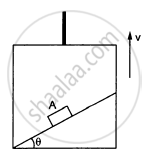
A block A can slide on a frictionless incline of angle θ and length l, kept inside an elevator going up with uniform velocity v in the following figure. Find the time taken by the block to slide down the length of the incline if it is released from the top of the incline.
A tennis ball and a cricket ball , both are stationary. To start motion in them .
A body of mass 5 kg is moving with velocity 2 m s-1. Calculate its linear momentum.
The linear momentum of a ball of mass 50 g is 0.5 kg m s-1. Find its velocity.
A force of 10 N acts on a body of mass 2 kg for 3 s, initially at rest. Calculate : Change in momentum of the body.
A force acts for 10 s on a stationary body of mass 100 kg, after which the force ceases to act. The body moves through a distance of 100 m in the next 5 s. Calculate : The magnitude of the force
Define Newton’s second law of motion.
A hockey player is moving northward and suddenly turns westward with the same speed to avoid an opponent. The force that acts on the player is ______.
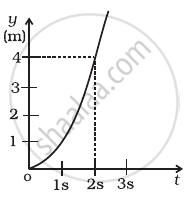
Figure shows (x, t), (y, t ) diagram of a particle moving in 2-dimensions.
|
|
 (b) |
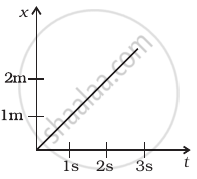
If the particle has a mass of 500 g, find the force (direction and magnitude) acting on the particle.
