Advertisements
Advertisements
Question
A man of mass 70 kg stands on a weighing scale in a lift which is moving
- upwards with a uniform speed of 10 m s-1
- downwards with a uniform acceleration of 5 m s–2
- upwards with a uniform acceleration of 5 m s–2. What would be the readings on the scale in each case?
- What would be the reading if the lift mechanism failed and it hurtled down freely under gravity?
Advertisements
Solution
Here, m = 70 kg, g = 10 m/s2
In each instance, the weighing machine measures the reaction R, which represents the apparent weight.
(a) When the lift moves upwards with a uniform speed, acceleration a = 0.
R = mg = 70 x 10 = 700 N
(b) When the lift moves downward with a = 5 ms-2
R = m (g - a) = 70 (10 - 5) = 350 N
(c) When the lift moves upwards with a = 5 ms-2
R = m (g + a) = 70 (10 + 5) = 1050 N
(d) If the lift were to come down freely under gravity, downward acceleration. a = g
∴ R = m (g - a) = m (g - g) = zero.
APPEARS IN
RELATED QUESTIONS
A constant retarding force of 50 N is applied to a body of mass 20 kg moving initially with a speed of 15 ms–1. How long does the body take to stop?
A batsman deflects a ball by an angle of 45° without changing its initial speed which is equal to 54 km/h. What is the impulse imparted to the ball? (Mass of the ball is 0.15 kg.)
A car accelerates on a horizontal road due to the force exerted by.
A particle of mass 0.3 kg is subjected to a force F = −kx with k = 15 N/m. What will be its initial acceleration if it is released from a point x = 20 cm?
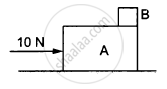
A small block B is placed on another block A of mass 5 kg and length 20 cm. Initially, the block B is near the right end of block A (In the following Figure). A constant horizontal force of 10 N is applied to the block A. All the surfaces are assumed frictionless. Find the time that elapses before block B separates from A.
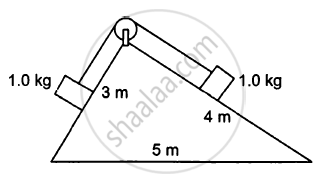
Consider the situation shown in the following figure All the surfaces are frictionless and the string and the pulley are light. Find the magnitude of acceleration of the two blocks.
Find the acceleration of the block of mass M in the situation shown in the following figure. All the surfaces are frictionless and the pulleys and the string are light.
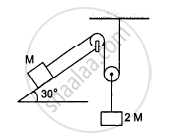
Find the mass M of the hanging block in the following figure that will prevent the smaller block from slipping over the triangular block. All the surfaces are frictionless and the strings and the pulleys are light.
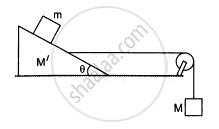
Find the acceleration of the blocks A and B in the three situations shown in the following figure.
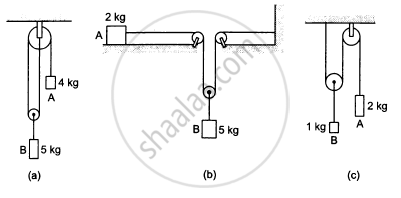
State the Newton's second law of motion. What information do you get from it?
The linear momentum of a body of mass m moving with velocity v is :
A force of 10 N acts on a body of mass 2 kg for 3 s, initially at rest. Calculate : The velocity acquired by the body
A force of 10 N acts on a body of mass 2 kg for 3 s, initially at rest. Calculate : Change in momentum of the body.
Why is it advantageous to turn before taking a long jump?
A stone is dropped from a cliff 98 m high.
What will be its speed when it strikes the ground?
A ball is thrown upward and reaches a maximum height of 19.6 m. Find its initial speed?
In the previous problem (5.3), the magnitude of the momentum transferred during the hit is ______.
Why does a child feel more pain when she falls down on a hard cement floor, than when she falls on the soft muddy ground in the garden?
What happens when a car brakes to come to a stop?
