Advertisements
Advertisements
Question
The linear momentum of a ball of mass 50 g is 0.5 kg m s-1. Find its velocity.
Advertisements
Solution
Linear momentum = 0.5 kg m/s
Mass, m = 50 g = 0.05 kg
Velocity = Linear momentum/mass
= 0.5/0.05 m/s
= 10 m/s -1
APPEARS IN
RELATED QUESTIONS
A rocket with a lift-off mass 20,000 kg is blasted upwards with an initial acceleration of 5.0 m s–2. Calculate the initial thrust (force) of the blast.
When a horse pulls a cart, the force that helps the horse to move forward is the force exerted by
A smooth wedge A is fitted in a chamber hanging from a fixed ceiling near the earth's surface. A block B placed at the top of the wedge takes time T to slide down the length of the wedge. If the block is placed at the top of the wedge and the cable supporting the chamber is broken at the same instant, the block will.
In the previous problem, suppose m2 = 2.0 kg and m3 = 3.0 kg. What should be the mass m, so that it remains at rest?
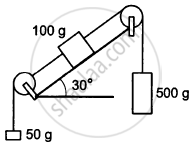
Find the acceleration of the 500 g block in the following figure.
An aeroplane is moving uniformly at a constant height under the action of two forces (i) Upward force (lift) and (ii) Downward force (weight). What is the net force on the aeroplane?
The linear momentum of a body of mass m moving with velocity v is :
Use Newton's second law to explain the following:
We always prefer to land on sand instead of hard floor while taking a high jump.
A stone is dropped from a cliff 98 m high.
How long will it take to fall to the foot of the cliff?
A stone is thrown vertically upward with a velocity of 9.8 m/s. When will it reach the ground?
