Advertisements
Advertisements
Question
A pebble is dropped freely in a well from its top. It takes 20 s for the pebble to reach the water surface in the well. Taking g = 10 m s-2 and speed of sound = 330 m s-1. Find : The depth of water surface
Advertisements
Solution
Time t =20 s
g = 10 m/s2
Let 'D' be the depth of the well.
Using the second equation of motion,
D = ut + (1/2) gt2
D = 0 + (1/2)(10)(20) 2
D = 2000 m
APPEARS IN
RELATED QUESTIONS
A person says that he measured the acceleration of a particle to be non-zero even though no force was acting on the particle.
A block of mass 0.2 kg is suspended from the ceiling by a light string. A second block of mass 0.3 kg is suspended from the first block by another string. Find the tensions in the two strings. Take g = 10 m/s2.
Two blocks A and B of mass mA and mB , respectively, are kept in contact on a frictionless table. The experimenter pushes block A from behind, so that the blocks accelerate. If block A exerts force F on block B, what is the force exerted by the experimenter on block A?
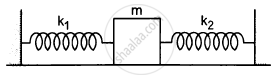
Both the springs shown in the following figure are unstretched. If the block is displaced by a distance x and released, what will be the initial acceleration?
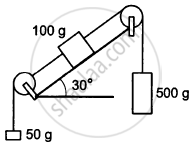
Find the acceleration of the 500 g block in the following figure.
Calculate the magnitude of force which when applied on a body of mass 0.5 kg produces an acceleration of 5 m s-2.
A force acts for 10 s on a stationary body of mass 100 kg, after which the force ceases to act. The body moves through a distance of 100 m in the next 5 s. Calculate: The velocity acquired by the body.
What do you mean by the conservation of momentum? Briefly, explain the collision between two bodies and the conservation of momentum.
In the previous problem (5.3), the magnitude of the momentum transferred during the hit is ______.
Why does a child feel more pain when she falls down on a hard cement floor, than when she falls on the soft muddy ground in the garden?
