Advertisements
Advertisements
Question
A ball is thrown vertically upwards. It returns 6 s later. Calculate the greatest height reached by the ball. (Take g = 10 m s−2)
Advertisements
Solution
Given:
Total time of journey = 6 s
g = 10 m/s2
Let h be the greatest height.
From the equation of motion,
`h = ut + 1/2 g t^2`
(we consider motion of ball from highest point to the ground.)
Since the total time for journey of the ball in air = 6 s.
Therefore, time for reaching maximum height = `6/2` = 3 s
For ascent, initial velocity, u = 0
Substituting the values in the formula, we get,
`h = (0 xx 3) + (1/2 xx 10 xx 3^2)`
h = 0 + (5 × 9)
h = 45 m
Hence, greatest height reached by the ball = 45 m
APPEARS IN
RELATED QUESTIONS
A rocket with a lift-off mass 20,000 kg is blasted upwards with an initial acceleration of 5.0 m s–2. Calculate the initial thrust (force) of the blast.
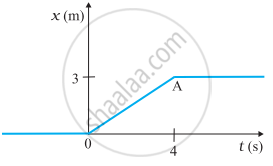
The below figure shows the position-time graph of a particle of mass 4 kg.
- What is the force on the particle for t < 0, t > 4 s, 0 < t < 4 s?
- What is the impulse at t = 0 and t = 4 s? (Consider one-dimensional motion only.)
A person is standing on a weighing machine placed on the floor of an elevator. The elevator starts going up with some acceleration, moves with uniform velocity for a while and finally decelerates to stop. The maximum and the minimum weights recorded are 72 kg and 60 kg, respectively. Assuming that the magnitudes of acceleration and deceleration are the same, find (a) the true weight of the person and (b) the magnitude of the acceleration. Take g = 9.9 m/s2.
State Newton's second law of motion. Under what condition does it take the form F = ma?
Calculate the magnitude of force which when applied on a body of mass 0.5 kg produces an acceleration of 5 m s-2.
A stone is dropped freely from the top of a tower and it reaches the ground in 4 s. Taking g = 10m s-2, calculate the height of the tower.
A stone is dropped from a cliff 98 m high.
What will be its speed when it strikes the ground?
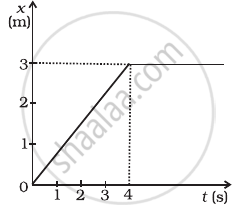
The position time graph of a body of mass 2 kg is as given in figure. What is the impulse on the body at t = 0 s and t = 4 s.
Why does a child feel more pain when she falls down on a hard cement floor, than when she falls on the soft muddy ground in the garden?
Why is catching a slow-moving ball easier than catching a fast-moving ball?
