Advertisements
Advertisements
Question
Define Newton’s second law of motion.
Advertisements
Solution
Newton’s second law of motion states that the rate of change of momentum is directly proportional to force applied and takes place in the direction of the force.
APPEARS IN
RELATED QUESTIONS
When a horse pulls a cart, the force that helps the horse to move forward is the force exerted by
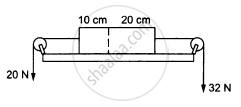
In the following figure shows a uniform rod of length 30 cm and mass 3.0 kg. The strings shown in the figure are pulled by constant forces of 20 N and 32 N. Find the force exerted by the 20 cm part of the rod on the 10 cm part. All the surfaces are smooth and the strings and the pulleys are light.
Define linear momentum and state its S.I. unit.
Show that the rate of change of momentum = mass × acceleration. Under what condition does this relation hold?
Two bodies A and B of same mass are moving with velocities v and 2v, respectively. Compare their (i) inertia and (ii) momentum.
Use Newton's second law of motion to explain the following instance :
An athlete prefers to land on sand instead of hard floor while taking a high jump .
Calculate the magnitude of force which when applied on a body of mass 0.5 kg produces an acceleration of 5 m s-2.
Multiple Choice Question. Select the correct option.
Which of the following are vector quantities?
Use Newton's second law to explain the following:
We always prefer to land on sand instead of hard floor while taking a high jump.
A woman throws an object of mass 500 g with a speed of 25 ms1.
- What is the impulse imparted to the object?
- If the object hits a wall and rebounds with half the original speed, what is the change in momentum of the object?
