Newton’s Second Law corrected the old belief that force is needed to maintain motion. This idea came from the philosopher ______.
Advertisements
Advertisements
Question
Two objects A and B are thrown upward simultaneously with the same speed. The mass of A is greater than that of B. Suppose the air exerts a constant and equal force of resistance on the two bodies.
Options
The two bodies will reach the same height.
A will go higher than B.
B will go higher than A.
Any of the above three may happen depending on the speed with which the objects are thrown.
MCQ
Advertisements
Solution
A will go higher than B.
Let the air exert a constant resistance force = F (in downward direction).
Acceleration of particle A in downward direction due to air resistance, aA = F/mA.
Acceleration of particle B in downward direction due to air resistance, aB = F/mB.
mA > mB
aA < aB
\[S = ut + \frac{1}{2}a t^2\]
\[So, H_A = ut - \frac{1}{2}( a_A + g) t^2\]
\[H_B = ut - \frac{1}{2}( a_B + g) t^2\]
\[H_A > H_B\]
Therefore, A will go higher than B.
shaalaa.com
Is there an error in this question or solution?
APPEARS IN
RELATED QUESTIONS
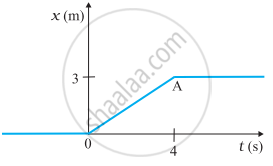
The below figure shows the position-time graph of a particle of mass 4 kg.
- What is the force on the particle for t < 0, t > 4 s, 0 < t < 4 s?
- What is the impulse at t = 0 and t = 4 s? (Consider one-dimensional motion only.)
An object is placed far away from all the objects that can exert force on it. A frame of reference is constructed by taking the origin and axes fixed in this object. Will the frame be necessarily inertial?
Two blocks of equal mass m are tied to each other through a light string. One of the blocks is pulled along the line joining them with a constant force F. Find the tension in the string joining the blocks.
A force \[\vec{F} = \vec{v} \times \vec{A}\] is exerted on a particle in addition to the force of gravity, where \[\vec{v}\] is the velocity of the particle and \[\vec{A}\] is a constant vector in the horizontal direction. With what minimum speed, a particle of mass m be projected so that it continues to move without being defelected and with a constant velocity?
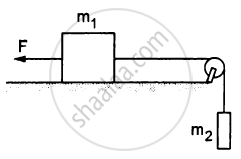
A constant force F = m2g/2 is applied on the block of mass m1 as shown in the following figure. The string and the pulley are light and the surface of the table is smooth. Find the acceleration of m1.
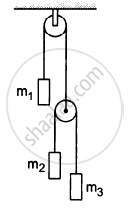
Let m1 = 1 kg, m2 = 2 kg and m3 = 3 kg in the following figure. Find the accelerations of m1, m2 and m3. The string from the upper pulley to m1 is 20 cm when the system is released from rest. How long will it take before m1 strikes the pulley?
Show that the rate of change of momentum = mass × acceleration. Under what condition does this relation hold?
Use Newton's second law of motion to explain the following instance :
An athlete prefers to land on sand instead of hard floor while taking a high jump .
A pebble is thrown vertically upwards with a speed of 20 m s-1. How high will it be after 2 s? (Take g = 10 m s-2)
An electron of mass 9 × 10⁻³¹ kg is moving with a linear velocity of 6 × 10⁷ ms−1. Calculate the linear momentum of electron.
Multiple Choice Question. Select the correct option.
Which of the following are vector quantities?
Name the physical entity used for quantifying the motion of a body.
What do you mean by linear momentum of a body?
Which of the following has the largest inertia?
A ball is thrown upward and reaches a maximum height of 19.6 m. Find its initial speed?
What do you mean by the conservation of momentum? Briefly, explain the collision between two bodies and the conservation of momentum.
Why is catching a slow-moving ball easier than catching a fast-moving ball?
