Advertisements
Advertisements
प्रश्न
Two objects A and B are thrown upward simultaneously with the same speed. The mass of A is greater than that of B. Suppose the air exerts a constant and equal force of resistance on the two bodies.
विकल्प
The two bodies will reach the same height.
A will go higher than B.
B will go higher than A.
Any of the above three may happen depending on the speed with which the objects are thrown.
Advertisements
उत्तर
A will go higher than B.
Let the air exert a constant resistance force = F (in downward direction).
Acceleration of particle A in downward direction due to air resistance, aA = F/mA.
Acceleration of particle B in downward direction due to air resistance, aB = F/mB.
mA > mB
aA < aB
\[S = ut + \frac{1}{2}a t^2\]
\[So, H_A = ut - \frac{1}{2}( a_A + g) t^2\]
\[H_B = ut - \frac{1}{2}( a_B + g) t^2\]
\[H_A > H_B\]
Therefore, A will go higher than B.
APPEARS IN
संबंधित प्रश्न
A car accelerates on a horizontal road due to the force exerted by.
A person says that he measured the acceleration of a particle to be non-zero even though no force was acting on the particle.
The force of buoyancy exerted by the atmosphere on a balloon is B in the upward direction and remains constant. The force of air resistance on the balloon acts opposite the direction of velocity and is proportional to it. The balloon carries a mass M and is found to fall to the earth's surface with a constant velocity v. How much mass should be removed from the balloon so that it may rise with a constant velocity v?
An empty plastic box of mass m is found to accelerate up at the rate of g/6 when placed deep inside water. How much sand should be put inside the box so that it may accelerate down at the rate of g/6?
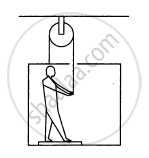
In the following figure shows a man of mass 60 kg standing on a light weighing machine kept in a box of mass 30 kg. The box is hanging from a pulley fixed to the ceiling by a light rope, the other end of which is held by the man himself. If the man manages to keep the box at rest, what is the weight recorded on the machine? What force should he exert on the rope to record his correct weight on the machine?
Define linear momentum and state its S.I. unit.
Show that the rate of change of momentum = mass × acceleration. Under what condition does this relation hold?
Write the mathematical form of Newton's second law of motion. State the conditions if any.
How can Newton's first law of motion be obtained from the second law of motion?
Use Newton's second law of motion to explain the following instance :
An athlete prefers to land on sand instead of hard floor while taking a high jump .
The linear momentum of a ball of mass 50 g is 0.5 kg m s-1. Find its velocity.
A force acts for 10 s on a stationary body of mass 100 kg, after which the force ceases to act. The body moves through a distance of 100 m in the next 5 s. Calculate : The magnitude of the force
Calculate the velocity of a body of mass 0.5 kg, when it has a linear momentum of 5 Ns.
What causes motion in a body?
State Newton's second law of motion.
A body of mass 400 g is resting on a frictionless table. Find the acceleration of the body when acted upon by a force of 0.02 N.
Use Newton's second law to explain the following:
While catching a fast moving ball, we always pull our hands backwards.
What do you mean by the conservation of momentum? Briefly, explain the collision between two bodies and the conservation of momentum.
A metre scale is moving with uniform velocity. This implies ______.
A body of mass 2 kg travels according to the law x(t) = pt + qt2 + rt3 where p = 3 ms−1, q = 4 ms−2 and r = 5 ms−3. The force acting on the body at t = 2 seconds is ______.
The motion of a particle of mass m is given by x = 0 for t < 0 s, x(t) = A sin 4 pt for 0 < t < (1/4) s (A > o), and x = 0 for t > (1/4) s. Which of the following statements is true?
- The force at t = (1/8) s on the particle is – 16π2 Am.
- The particle is acted upon by on impulse of magnitude 4π2 A m at t = 0 s and t = (1/4) s.
- The particle is not acted upon by any force.
- The particle is not acted upon by a constant force.
- There is no impulse acting on the particle.
