Newton’s Second Law corrected the old belief that force is needed to maintain motion. This idea came from the philosopher ______.
Advertisements
Advertisements
प्रश्न
Define linear momentum and state its S.I. unit.
टिप्पणी लिखिए
Advertisements
उत्तर
Linear momentum of a body is the product of its mass and velocity.
Its SI unit is kgms-1.
shaalaa.com
क्या इस प्रश्न या उत्तर में कोई त्रुटि है?
APPEARS IN
संबंधित प्रश्न
When a horse pulls a cart, the force that helps the horse to move forward is the force exerted by
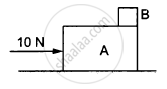
A small block B is placed on another block A of mass 5 kg and length 20 cm. Initially, the block B is near the right end of block A (In the following Figure). A constant horizontal force of 10 N is applied to the block A. All the surfaces are assumed frictionless. Find the time that elapses before block B separates from A.
A person is standing on a weighing machine placed on the floor of an elevator. The elevator starts going up with some acceleration, moves with uniform velocity for a while and finally decelerates to stop. The maximum and the minimum weights recorded are 72 kg and 60 kg, respectively. Assuming that the magnitudes of acceleration and deceleration are the same, find (a) the true weight of the person and (b) the magnitude of the acceleration. Take g = 9.9 m/s2.
An empty plastic box of mass m is found to accelerate up at the rate of g/6 when placed deep inside water. How much sand should be put inside the box so that it may accelerate down at the rate of g/6?
The linear momentum of a body of mass m moving with velocity v is :
A force acts for 10 s on a stationary body of mass 100 kg, after which the force ceases to act. The body moves through a distance of 100 m in the next 5 s. Calculate : The magnitude of the force
Prove mathematically F = ma
According to Newton's Second Law of Motion, what quantity is directly proportional to the applied force?
What happens when a car brakes to come to a stop?
