Newton’s Second Law corrected the old belief that force is needed to maintain motion. This idea came from the philosopher ______.
Advertisements
Advertisements
प्रश्न
A stone is dropped freely from the top of a tower and it reaches the ground in 4 s. Taking g = 10m s-2, calculate the height of the tower.
योग
Advertisements
उत्तर
Initial velocity u = 0
Time t = 4 s
g = 10 m/s2
Let 'H' be the height of the tower.
Using the second equation of motion,
H = ut + (1/2) gt2
Or, H = 0 + (1/2)(10)(4)2
Or, H = 80 m
shaalaa.com
क्या इस प्रश्न या उत्तर में कोई त्रुटि है?
APPEARS IN
संबंधित प्रश्न
A spy jumps from an airplane with his parachute. The spy accelerates downward for some time when the parachute opens. The acceleration is suddenly checked and the spy slowly falls to the ground. Explain the action of the parachute in checking the acceleration.
A block of mass m is placed on a smooth wedge of inclination θ. The whole system is accelerated horizontally so that the block does not slip on the wedge. The force exerted by the wedge on the block has a magnitude.
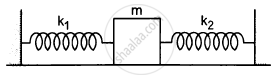
Both the springs shown in the following figure are unstretched. If the block is displaced by a distance x and released, what will be the initial acceleration?
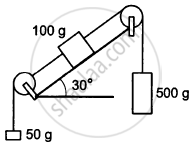
Find the acceleration of the 500 g block in the following figure.
The linear momentum of a ball of mass 50 g is 0.5 kg m s-1. Find its velocity.
Define Newton’s second law of motion.
ame the law of motion which gives the definition of force.
Use Newton's second law to explain the following:
We always prefer to land on sand instead of hard floor while taking a high jump.
A stone is dropped from a tower 98 m high. With what speed should a second stone be thrown 1 s later so that both hit the ground at the same time?
