Advertisements
Advertisements
Question
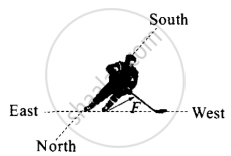
A hockey player is moving northward and suddenly turns westward with the same speed to avoid an opponent. The force that acts on the player is ______.
Options
frictional force along westward.
muscle force along southward.
frictional force along south-west.
muscle force along south-west.
Advertisements
Solution
A hockey player is moving northward and suddenly turns westward with the same speed to avoid an opponent. The force that acts on the player is frictional force along south-west.
Explanation:
According to Newton’s second law of motion, only external forces can change the linear momentum of the system. The internal forces cannot change the linear momentum of system under consideration. If we take hockey players as a system, the external force which can change the direction of motion of the player is the force that must be friction between the ground and the shoes of player. The muscle force is the internal force, this cannot change the linear momentum of the player.
According to Newton’s Second Law, The rate of change of linear momentum of a body is equal to the external force applied on the body or F = dp/dt. So, the external force must be in the direction of change in momentum.
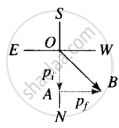
As shown in the diagram,
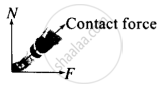
Let OA = p1
= Initial momentum of player northward
AB = p2
= Final momentum of the player towards west
Clearly OB = OA + AB
According to the problem, mass = 2 kg
The position of the particle is given here as a function of time, x(t) = pt + qt2 + rt3 By differentiating this equation w.r.t. time we get velocity of the particle as a function of time.
v = dx/dt = p + 2 qt + 3 rt2
If we again differentiate this equation w.r.t. time, we will get an acceleration of the particle as a function of time.
a = dv/dt = 0 + 2q + 6rt
At t = 2 s; a = 2q + 6 × 2 × r
= 2 q + 12 r
= 2 × 4 + 12 × 5
= 8 + 60
= 68 m/s
Force = F = ma
= 2 × 68
= 136 N
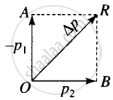
Change in momentum = p2 – p1
= AB – OA
= AB + (– OA)
= Clearly the change in momentum is OR will be along southwest, so the direction of force will also be along southwest.
APPEARS IN
RELATED QUESTIONS
A rocket with a lift-off mass 20,000 kg is blasted upwards with an initial acceleration of 5.0 m s–2. Calculate the initial thrust (force) of the blast.
A block of mass 15 kg is placed on a long trolley. The coefficient of static friction between the block and the trolley is 0.18. The trolley accelerates from rest with 0.5 ms–2 for 20 s and then moves with uniform velocity. Discuss the motion of the block as viewed by (a) a stationary observer on the ground, (b) an observer moving with the trolley.
You are travelling in a car. The driver suddenly applies the brakes and you are pushed forward. Why does this happen?
A smooth wedge A is fitted in a chamber hanging from a fixed ceiling near the earth's surface. A block B placed at the top of the wedge takes time T to slide down the length of the wedge. If the block is placed at the top of the wedge and the cable supporting the chamber is broken at the same instant, the block will.
A person says that he measured the acceleration of a particle to be non-zero even though no force was acting on the particle.
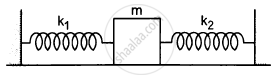
Both the springs shown in the following figure are unstretched. If the block is displaced by a distance x and released, what will be the initial acceleration?
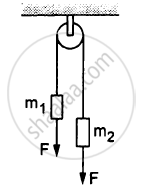
In the following figure, m1 = 5 kg, m2 = 2 kg and F = 1 N. Find the acceleration of either block. Describe the motion of m1 if the string breaks but F continues to act.
In the previous problem, suppose m2 = 2.0 kg and m3 = 3.0 kg. What should be the mass m, so that it remains at rest?
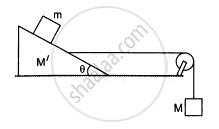
Find the mass M of the hanging block in the following figure that will prevent the smaller block from slipping over the triangular block. All the surfaces are frictionless and the strings and the pulleys are light.
Define linear momentum and state its S.I. unit.
State the Newton's second law of motion. What information do you get from it?
How can Newton's first law of motion be obtained from the second law of motion?
Use Newton's second law of motion to explain the following instance :
A cricketer pulls his hands back while catching a fast moving cricket ball .
A body of mass 5 kg is moving with velocity 2 m s-1. Calculate its linear momentum.
A force acts for 10 s on a stationary body of mass 100 kg, after which the force ceases to act. The body moves through a distance of 100 m in the next 5 s. Calculate : The magnitude of the force
A body of mass 200 g is moving with a velocity of 5 ms−1. If the velocity of the body changes to 17 ms−1, calculate the change in linear momentum of the body.
Multiple Choice Question. Select the correct option.
A force acts on a body of mass 3 kg such that its velocity changes from 4 ms−1 to 10 ms−1. The change in momentum of the body is
What do you mean by linear momentum of a body?
