Advertisements
Advertisements
Question
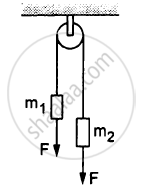
In the following figure, m1 = 5 kg, m2 = 2 kg and F = 1 N. Find the acceleration of either block. Describe the motion of m1 if the string breaks but F continues to act.
Advertisements
Solution
Let the acceleration of the blocks be a.
The free-body diagrams for both the blocks are shown below: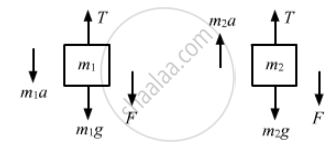
From the free-body diagram,
m1a = m1g + F − T ...(i)
Again, from the free-body diagram,
m2a = T − m2g − F ...(ii)
Adding equations (i) and (ii), we have:
\[a = g\frac{m_1 - m_2}{m_1 + m_2}\]
\[\Rightarrow a = \frac{3g}{7} = \frac{29 . 4}{7}\]
\[ = 4 . 2 m/ s^2\]
After the string breaks, m1 moves downward with force F acting downward. Then,
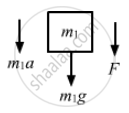
m1a = F + m1g
5a = 1 + 5g
\[\Rightarrow a = \frac{5g + 1}{5}\]
\[ = g + 0 . 2 m/ s^2\]
APPEARS IN
RELATED QUESTIONS
A constant retarding force of 50 N is applied to a body of mass 20 kg moving initially with a speed of 15 ms–1. How long does the body take to stop?
A rocket with a lift-off mass 20,000 kg is blasted upwards with an initial acceleration of 5.0 m s–2. Calculate the initial thrust (force) of the blast.
A batsman deflects a ball by an angle of 45° without changing its initial speed which is equal to 54 km/h. What is the impulse imparted to the ball? (Mass of the ball is 0.15 kg.)
Explain why a cricketer moves his hands backwards while holding a catch.
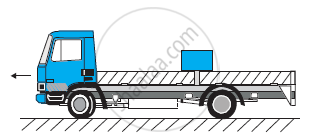
The rear side of a truck is open and a box of 40 kg mass is placed 5 m away from the open end as shown in Figure. The coefficient of friction between the box and the surface below it is 0.15. On a straight road, the truck starts from rest and accelerates with 2 m s–2. At what distance from the starting point does the box fall off the truck? (Ignore the size of the box).
A free 238U nucleus kept in a train emits an alpha particle. When the train is stationary, a nucleus decays and a passenger measures that the separation between the alpha particle and the recoiling nucleus becomes x at time t after the decay. If the decay takes place while the train is moving at a uniform velocity v, the distance between the alpha particle and the recoiling nucleus at a time t after the decay, as measured by the passenger, is
A particle of mass 0.3 kg is subjected to a force F = −kx with k = 15 N/m. What will be its initial acceleration if it is released from a point x = 20 cm?
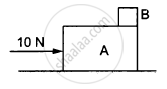
A small block B is placed on another block A of mass 5 kg and length 20 cm. Initially, the block B is near the right end of block A (In the following Figure). A constant horizontal force of 10 N is applied to the block A. All the surfaces are assumed frictionless. Find the time that elapses before block B separates from A.
Suppose the ceiling in the previous problem is that of an elevator which is going up with an acceleration of 2.0 m/s2. Find the elongation.
The force of buoyancy exerted by the atmosphere on a balloon is B in the upward direction and remains constant. The force of air resistance on the balloon acts opposite the direction of velocity and is proportional to it. The balloon carries a mass M and is found to fall to the earth's surface with a constant velocity v. How much mass should be removed from the balloon so that it may rise with a constant velocity v?
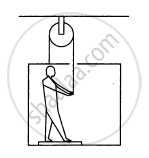
In the following figure shows a man of mass 60 kg standing on a light weighing machine kept in a box of mass 30 kg. The box is hanging from a pulley fixed to the ceiling by a light rope, the other end of which is held by the man himself. If the man manages to keep the box at rest, what is the weight recorded on the machine? What force should he exert on the rope to record his correct weight on the machine?
The linear momentum of a body of mass m moving with velocity v is :
A force of 10 N acts on a body of mass 2 kg for 3 s, initially at rest. Calculate : Change in momentum of the body.
State two factors which determine the momentum of a body.
Define Newton’s second law of motion.
Multiple Choice Question. Select the correct option.
The impulse of a body is equal to:
Multiple Choice Question. Select the correct option.
Which of the following are vector quantities?
Use Newton's second law to explain the following:
We always prefer to land on sand instead of hard floor while taking a high jump.
A stone is dropped from a cliff 98 m high.
What will be its speed when it strikes the ground?
In the previous problem (5.3), the magnitude of the momentum transferred during the hit is ______.
