Advertisements
Advertisements
Question
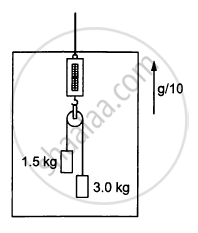
Find the reading of the spring balance shown in the following figure. The elevator is going up with an acceleration g/10, the pulley and the string are light and the pulley is smooth.
Advertisements
Solution
Let the left and right blocks be A and B, respectively.
And let the acceleration of the 3 kg mass relative to the elevator be 'a' in the downward direction.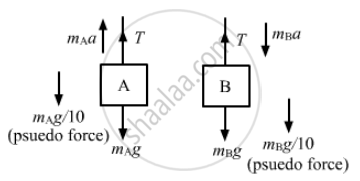
From the free-body diagram,
\[m_A a = T - m_A g - \frac{m_A g}{10} . . . \left( 1 \right)\]
\[m_B a = m_B g + \frac{m_B g}{10} - T . . . \left( 2 \right)\]
Adding both the equations, we get:
\[a\left( m_A + m_B \right) = \left( m_B - m_A \right)g + \left( m_B - m_A \right)\frac{g}{10}\]
Putting value of the masses,we get:
\[9a = \frac{33g}{10}\]
\[ \Rightarrow \frac{a}{g} = \frac{11}{30} . . . \left( 3 \right)\]
Now, using equation (1), we get:
\[T = m_A \left( a + g + \frac{g}{10} \right)\]
The reading of the spring balance =\[\frac{2T}{g} = \frac{2}{g} m_A \left( a + g + \frac{g}{10} \right)\]
\[\Rightarrow 2 \times 1 . 5\left( \frac{a}{g} + 1 + \frac{1}{10} \right) = 3\left( \frac{11}{30} + 1 + \frac{1}{10} \right)\]
= 4 . 4 kg
APPEARS IN
RELATED QUESTIONS
When a horse pulls a cart, the force that helps the horse to move forward is the force exerted by
Two objects A and B are thrown upward simultaneously with the same speed. The mass of A is greater than that of B. Suppose the air exerts a constant and equal force of resistance on the two bodies.
A smooth wedge A is fitted in a chamber hanging from a fixed ceiling near the earth's surface. A block B placed at the top of the wedge takes time T to slide down the length of the wedge. If the block is placed at the top of the wedge and the cable supporting the chamber is broken at the same instant, the block will.
Two blocks of equal mass m are tied to each other through a light string. One of the blocks is pulled along the line joining them with a constant force F. Find the tension in the string joining the blocks.
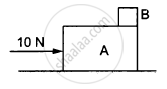
A small block B is placed on another block A of mass 5 kg and length 20 cm. Initially, the block B is near the right end of block A (In the following Figure). A constant horizontal force of 10 N is applied to the block A. All the surfaces are assumed frictionless. Find the time that elapses before block B separates from A.
A person is standing on a weighing machine placed on the floor of an elevator. The elevator starts going up with some acceleration, moves with uniform velocity for a while and finally decelerates to stop. The maximum and the minimum weights recorded are 72 kg and 60 kg, respectively. Assuming that the magnitudes of acceleration and deceleration are the same, find (a) the true weight of the person and (b) the magnitude of the acceleration. Take g = 9.9 m/s2.
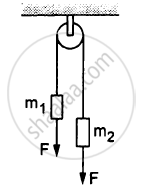
In the following figure, m1 = 5 kg, m2 = 2 kg and F = 1 N. Find the acceleration of either block. Describe the motion of m1 if the string breaks but F continues to act.
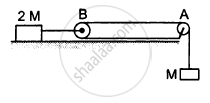
Consider the situation shown in the following figure. Both the pulleys and the string are light and all the surfaces are frictionless.
- Find the acceleration of the mass M.
- Find the tension in the string.
- Calculate the force exerted by the clamp on the pulley A in the figure.
An aeroplane is moving uniformly at a constant height under the action of two forces (i) Upward force (lift) and (ii) Downward force (weight). What is the net force on the aeroplane?
Show that the rate of change of momentum = mass × acceleration. Under what condition does this relation hold?
Two bodies A and B of same mass are moving with velocities v and 2v, respectively. Compare their (i) inertia and (ii) momentum.
State Newton's second law of motion. Under what condition does it take the form F = ma?
Use Newton's second law of motion to explain the following instance :
An athlete prefers to land on sand instead of hard floor while taking a high jump .
A body of mass 5 kg is moving with velocity 2 m s-1. Calculate its linear momentum.
A ball is thrown vertically upwards. It returns 6 s later. Calculate the greatest height reached by the ball. (Take g = 10 m s−2)
What do you mean by an impulsive force?
A stone is dropped from a cliff 98 m high.
How long will it take to fall to the foot of the cliff?
The motion of a particle of mass m is given by x = 0 for t < 0 s, x(t) = A sin 4 pt for 0 < t < (1/4) s (A > o), and x = 0 for t > (1/4) s. Which of the following statements is true?
- The force at t = (1/8) s on the particle is – 16π2 Am.
- The particle is acted upon by on impulse of magnitude 4π2 A m at t = 0 s and t = (1/4) s.
- The particle is not acted upon by any force.
- The particle is not acted upon by a constant force.
- There is no impulse acting on the particle.
According to Newton's Second Law of Motion, what quantity is directly proportional to the applied force?
