Newton’s Second Law corrected the old belief that force is needed to maintain motion. This idea came from the philosopher ______.
Advertisements
Advertisements
प्रश्न
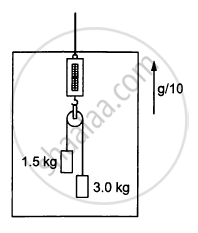
Find the reading of the spring balance shown in the following figure. The elevator is going up with an acceleration g/10, the pulley and the string are light and the pulley is smooth.
बेरीज
Advertisements
उत्तर
Let the left and right blocks be A and B, respectively.
And let the acceleration of the 3 kg mass relative to the elevator be 'a' in the downward direction.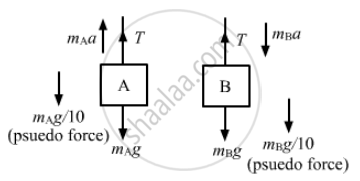
From the free-body diagram,
\[m_A a = T - m_A g - \frac{m_A g}{10} . . . \left( 1 \right)\]
\[m_B a = m_B g + \frac{m_B g}{10} - T . . . \left( 2 \right)\]
Adding both the equations, we get:
\[a\left( m_A + m_B \right) = \left( m_B - m_A \right)g + \left( m_B - m_A \right)\frac{g}{10}\]
Putting value of the masses,we get:
\[9a = \frac{33g}{10}\]
\[ \Rightarrow \frac{a}{g} = \frac{11}{30} . . . \left( 3 \right)\]
Now, using equation (1), we get:
\[T = m_A \left( a + g + \frac{g}{10} \right)\]
The reading of the spring balance =\[\frac{2T}{g} = \frac{2}{g} m_A \left( a + g + \frac{g}{10} \right)\]
\[\Rightarrow 2 \times 1 . 5\left( \frac{a}{g} + 1 + \frac{1}{10} \right) = 3\left( \frac{11}{30} + 1 + \frac{1}{10} \right)\]
= 4 . 4 kg
shaalaa.com
या प्रश्नात किंवा उत्तरात काही त्रुटी आहे का?
APPEARS IN
संबंधित प्रश्न
A body of mass 0.40 kg moving initially with a constant speed of 10 m s–1 to the north is subject to a constant force of 8.0 N directed towards the south for 30 s. Take the instant the force is applied to be t = 0, the position of the body at that time to be x = 0, and predict its position at t = –5 s, 25 s, 100 s.
A stone of mass m tied to the end of a string revolves in a vertical circle of radius R. The net forces at the lowest and highest points of the circle directed vertically downwards are: [Choose the correct alternative]
| Lowest Point | Highest Point | |
| a) | mg – T1 | mg + T2 |
| b) | mg + T1 | mg – T2 |
| c) | `mg + T1 –(m_v_1^2)/R` | mg – T2 + (`mv_1^2`)/R |
| d) | `mg – T1 – (mv)/R` | mg + T2 + (mv_1^2)/R |
T1 and v1 denote the tension and speed at the lowest point. T2 and v2 denote corresponding values at the highest point.
When a horse pulls a cart, the force that helps the horse to move forward is the force exerted by
A man has fallen into a ditch of width d and two of his friends are slowly pulling him out using a light rope and two fixed pulleys as shown in the following figure. Show that the force (assumed equal for both the friends) exerted by each friend on the road increases as the man moves up. Find the force when the man is at a depth h.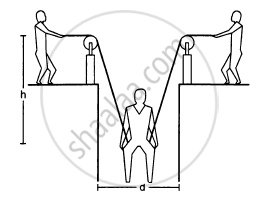
In a simple Atwood machine, two unequal masses m1 and m2 are connected by a string going over a clamped light smooth pulley. In a typical arrangement (In the following figure), m1 = 300 g and m2 = 600 g. The system is released from rest. (a) Find the distance travelled by the first block in the first two seconds; (b) find the tension in the string; (c) find the force exerted by the clamp on the pulley.
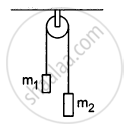
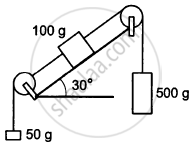
Find the acceleration of the 500 g block in the following figure.
The linear momentum of a ball of mass 50 g is 0.5 kg m s-1. Find its velocity.
What do you understand by the term momentum?
ame the law of motion which gives the definition of force.
What do you mean by linear momentum of a body? A force causes an acceleration of 10 ms-2 in a body of mass 1 kg. What acceleration will be caused by the same force in a body of mass 4 kg?
A stone is dropped from a cliff 98 m high.
How long will it take to fall to the foot of the cliff?
A stone is dropped from a cliff 98 m high.
What will be its speed when it strikes the ground?
A ball is thrown upward and reaches a maximum height of 19.6 m. Find its initial speed?
The INCORRECT statement about Newton's second law of motion is
A cricket ball of mass 150 g has an initial velocity `u = (3hati + 4hatj)` m s−1 and a final velocity `v = - (3hati + 4hatj)` m s−1 after being hit. The change in momentum (final momentum-initial momentum) is (in kg m s1)
Why is catching a slow-moving ball easier than catching a fast-moving ball?
