Advertisements
Advertisements
प्रश्न
You are travelling in a car. The driver suddenly applies the brakes and you are pushed forward. Why does this happen?
Advertisements
उत्तर
We are pushed forward because of the inertia of motion, as our body opposes the sudden change.
APPEARS IN
संबंधित प्रश्न
A constant retarding force of 50 N is applied to a body of mass 20 kg moving initially with a speed of 15 ms–1. How long does the body take to stop?
A rocket with a lift-off mass 20,000 kg is blasted upwards with an initial acceleration of 5.0 m s–2. Calculate the initial thrust (force) of the blast.
Explain why a cricketer moves his hands backwards while holding a catch.
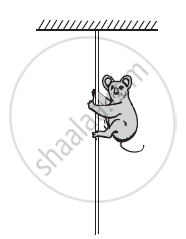
A monkey of mass 40 kg climbs on a rope in given Figure which can stand a maximum tension of 600 N. In which of the following cases will the rope break: the monkey
(a) climbs up with an acceleration of 6 m s–2
(b) climbs down with an acceleration of 4 m s–2
(c) climbs up with a uniform speed of 5 m s–1
(d) falls down the rope nearly freely under gravity?
(Ignore the mass of the rope).
A block of mass 15 kg is placed on a long trolley. The coefficient of static friction between the block and the trolley is 0.18. The trolley accelerates from rest with 0.5 ms–2 for 20 s and then moves with uniform velocity. Discuss the motion of the block as viewed by (a) a stationary observer on the ground, (b) an observer moving with the trolley.
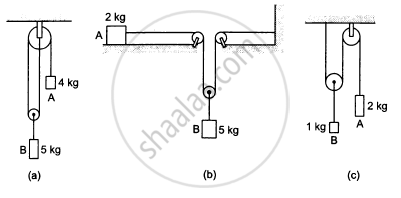
Find the acceleration of the blocks A and B in the three situations shown in the following figure.
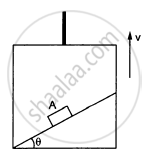
A block A can slide on a frictionless incline of angle θ and length l, kept inside an elevator going up with uniform velocity v in the following figure. Find the time taken by the block to slide down the length of the incline if it is released from the top of the incline.
A tennis ball and a cricket ball , both are stationary. To start motion in them .
A body of mass 5 kg is moving with velocity 2 m s-1. Calculate its linear momentum.
The linear momentum of a ball of mass 50 g is 0.5 kg m s-1. Find its velocity.
A force of 10 N acts on a body of mass 2 kg for 3 s, initially at rest. Calculate : Change in momentum of the body.
Calculate the velocity of a body of mass 0.5 kg, when it has a linear momentum of 5 Ns.
State two factors which determine the momentum of a body.
Which of the following has the largest inertia?
A ball is thrown upward and reaches a maximum height of 19.6 m. Find its initial speed?
In the previous problem (5.3), the magnitude of the momentum transferred during the hit is ______.
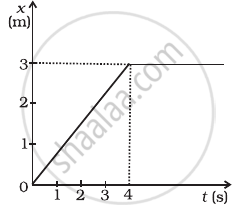
The position time graph of a body of mass 2 kg is as given in figure. What is the impulse on the body at t = 0 s and t = 4 s.
How does moving your hand backward while catching a cricket ball reduce pain?
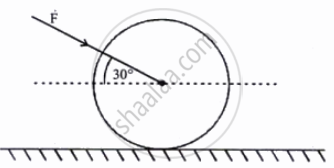
As shown in figure, a 70 kg garden roller is pushed with a force of F = 200 N at an angle of 30° with horizontal. The normal reaction on the roller is: (Given: g = 10 ms−2)