Advertisements
Advertisements
प्रश्न
State two factors which determine the momentum of a body.
Advertisements
उत्तर
Factors which determine the momentum of a body are:
- Mass of the moving body: Larger the mass of a body, larger will be its momentum.
- Velocity of the body: Larger the velocity of the body, larger will be its momentum.
APPEARS IN
संबंधित प्रश्न
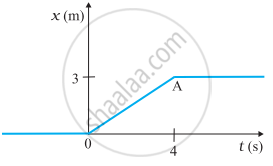
The below figure shows the position-time graph of a particle of mass 4 kg.
- What is the force on the particle for t < 0, t > 4 s, 0 < t < 4 s?
- What is the impulse at t = 0 and t = 4 s? (Consider one-dimensional motion only.)
You are travelling in a car. The driver suddenly applies the brakes and you are pushed forward. Why does this happen?
Suppose you are running fast in a field and suddenly find a snake in front of you. You stop quickly. Which force is responsible for your deceleration?
A smooth wedge A is fitted in a chamber hanging from a fixed ceiling near the earth's surface. A block B placed at the top of the wedge takes time T to slide down the length of the wedge. If the block is placed at the top of the wedge and the cable supporting the chamber is broken at the same instant, the block will.
A force \[\vec{F} = \vec{v} \times \vec{A}\] is exerted on a particle in addition to the force of gravity, where \[\vec{v}\] is the velocity of the particle and \[\vec{A}\] is a constant vector in the horizontal direction. With what minimum speed, a particle of mass m be projected so that it continues to move without being defelected and with a constant velocity?
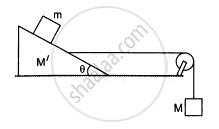
Find the mass M of the hanging block in the following figure that will prevent the smaller block from slipping over the triangular block. All the surfaces are frictionless and the strings and the pulleys are light.
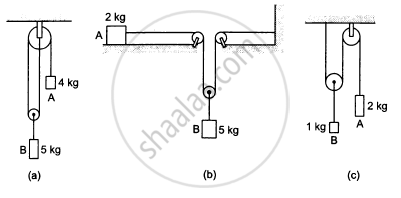
Find the acceleration of the blocks A and B in the three situations shown in the following figure.
A tennis ball and a cricket ball , both are stationary. To start motion in them .
An electron of mass 9 × 10⁻³¹ kg is moving with a linear velocity of 6 × 10⁷ ms−1. Calculate the linear momentum of electron.
Name the physical quantity which equals the rate of change of linear momentum.
