Advertisements
Advertisements
प्रश्न
Is it possible for a particle to describe a curved path if no force acts on it? Does your answer depend on the frame of reference chosen to view the particle?
Advertisements
उत्तर
If no force acts on the particle it cannot change its direction. So, it is not possible for a particle to describe a curved path if no force acts on it.
Yes, the answer depends on the frame of reference chosen to view the particle if the frame of reference describes a curved path.
APPEARS IN
संबंधित प्रश्न
A moving bicycle comes to rest after sometime if we stop pedalling it. But Newton’s first law of motion says that a moving body should continue to move for ever, unless some external force acts on it. How do you explain the bicycle case ?
Three rigid rods are joined to form an equilateral triangle ABC of side 1 m. Three particles carrying charges 20 μC each are attached to the vertices of the triangle. The whole system is at rest in an inertial frame. The magnitude of the resultant force on the charged particle at A is.
A force F1 acts on a particle accelerating it from rest to a velocity v. Force F1 is then replaced by F2 which decelerates the particle to rest.
A particle stays at rest as seen in a frame. We can conclude that
(a) the frame is inertial
(b) resultant force on the particle is zero
(c) the frame may be inertial but the resultant force on the particle is zero
(d) the frame may be non-inertial but there is a non-zero resultant force
A particle is found to be at rest when seen from a frame S1 and moving with constant velocity when seen from another frame S2. Mark out the possible options.
(a) Both the frames are inertial.
(b) Both the frames are non-inertial.
(c) S1 is inertial and S2 is non-inertial.
(d) S1 is non-inertial and S2 is inertial
The force exerted by the floor of an elevator on the foot of a person is more than the weight of the person if the elevator is
(a) going up and slowing down
(b) going up and speeding up
(c) going down and slowing down
(d) going down and speeding up
An object of mass 2 kg is sliding with a constant velocity of 4 m/s on a frictionless horizontal table. The force required to keep this object moving with the same velocity is :
A force of 600 dynes acts on a glass ball of mass 200 g for 12 s. If initially, the ball is at rest, find
- Final velocity
- Distance covered.
What do you mean by inertia of motion?
What do you mean by inertia of rest?
Classify the types of force based on their application.
Newton's first law of motion describes ______.
A body of mass 10 kg is acted upon by two perpendicular forces, 6 N and 8 N. The resultant acceleration of the body is ______.
- 1 m s–2 at an angle of tan−1 `(4/3)` w.r.t 6 N force.
- 0.2 m s–2 at an angle of tan−1 `(4/3)` w.r.t 6 N force.
- 1 m s–2 at an angle of tan−1 `(3/4)` w.r.t 8 N force.
- 0.2 m s–2 at an angle of tan−1 `(3/4)` w.r.t 8 N force.
A mass of 2 kg is suspended with thread AB (Figure). Thread CD of the same type is attached to the other end of 2 kg mass. Lower thread is pulled gradually, harder and harder in the downward directon so as to apply force on AB. Which of the threads will break and why?
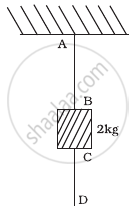
In the above given problem if the lower thread is pulled with a jerk, what happens?
A force F is applied to the initially stationary cart. The variation of force with time is shown in the figure. The speed of the cart at t = 5 sec is ______.

A balloon has mass of 10 g in air. The air escapes from the balloon at a uniform rate with velocity 4.5 cm/s. If the balloon shrinks in 5 s completely. Then, the average force acting on that balloon will be (in dyne).
An interstellar spacecraft, far away from the influence of any star or planet, is moving at high speed under the influence of fusion rockets (due to the thrust exerted by fusion rockets, the spacecraft is accelerating). Suddenly the engine malfunctions and stops. The spacecraft will ______.
