Advertisements
Advertisements
प्रश्न
An object of mass 2 kg is sliding with a constant velocity of 4 m/s on a frictionless horizontal table. The force required to keep this object moving with the same velocity is :
पर्याय
32 N
0 N
2 N
8 N
Advertisements
उत्तर
0 N
Explanation:
The object will keep on moving on a frictionless horizontal surface by itself due to Newton’s First law of motion.
संबंधित प्रश्न
Consider a book lying on a table. The weight of the book and the normal force by the table in the book are equal in magnitude and opposite in direction. Is this an example of Newton's third law?
A particle is observed from two frames S1 and S2. Frame S2 moves with respect to S1with an acceleration a. Let F1 and F2 be the pseudo forces on the particle when seen from S1 and S2, respectively. Which of the following is not possible?
Give qualitative definition of force on the basic of Newton's first law of motion.
How does Newton's second law of motion differ from the first law of motion?
Derive the relation between newton and dyne.
What do you mean by inertia of motion?
Differentiate between gravitational mass and inertial mass.
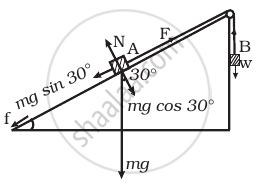
Block A of weight 100 N rests on a frictionless inclined plane of slope angle 30° (figure). A flexible cord attached to A passes over a frictonless pulley and is connected to block B of weight W. Find the weight W for which the system is in equilibrium.
Two blocks A and B of masses m and 2 m, respectively, are held at rest such that the spring is in natural length. Find out the accelerations of both the blocks just after release.

This question has Statement 1 and Statement 2. Of the four choices given after the Statements, choose the one that best describes the two Statements.
Statement 1: If you push on a cart being pulled by a horse so that it does not move, the cart pushes you back with an equal and opposite force.
Statement 2: The cart does not move because the force described in statement 1 cancel each other.
